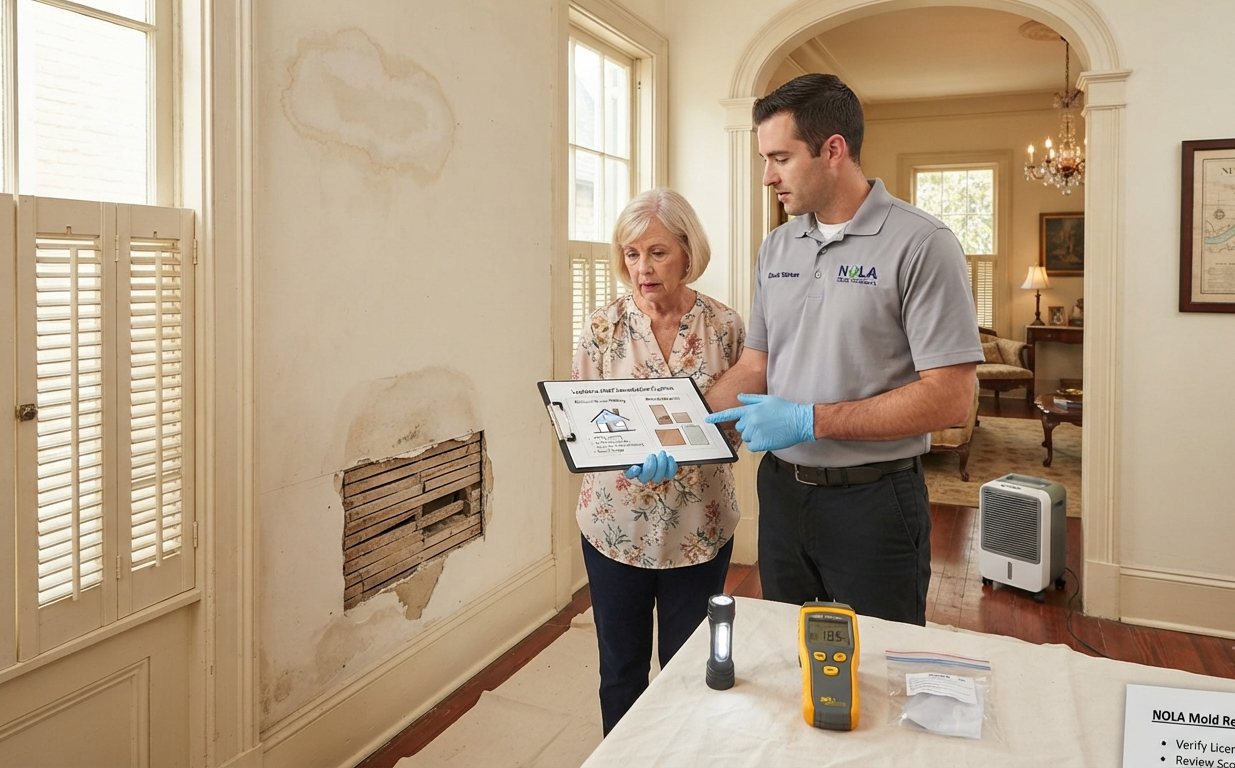
A ceiling stain that darkens after rain, a musty odor near an air handler, or wet drywall after a plumbing leak can quickly lead to conflicting estimates and sales claims. Learning how to choose a mold remediation company in New Orleans begins with one practical test: can the company explain the moisture source, affected materials, and proposed work in plain language? In a warm, humid city where roof leaks, HVAC condensation, crawl-space dampness, and storm water can overlap, the building story should come before the treatment pitch.
Quick Answer
- Verify Louisiana mold-remediation licensing when the project falls within the state’s licensing threshold.
- Ask what caused the moisture, or what still must be investigated.
- Require a written scope covering rooms, materials, containment, drying, disposal, exclusions, and completion.
- Compare estimates line by line rather than choosing by total price.
- Ask who issued every “certification,” who holds it, and what work it covers.
- Avoid color-based diagnoses, automatic testing packages, permanent-coating promises, and verbal-only scopes.
Start With the Scope, Not the Sales Pitch
The right company should define the problem before selling the solution. A polished pitch means little if no one has connected the visible clue to moisture, material damage, and access.
What clue brought you to the company?
Start with what you know: an odor that returns when the AC runs, staining near a baseboard, damp insulation after a roof leak, or growth inside a sink cabinet. A useful contractor will ask where it appears, when it changes, what became wet, and whether the area was repaired before.
Is the area still wet?
If materials remain wet, source control and drying come before cosmetic treatment. After rain or a plumbing failure, a surface may feel dry while insulation, subflooring, or wall cavities remain damp.
Do you need assessment, cleanup, remediation, or rebuilding?
Assessment identifies conditions; cleanup addresses affected surfaces; remediation controls and removes contaminated materials; rebuilding replaces finishes removed during the work. Before comparing companies, understand the difference between removal and remediation, then confirm which services appear in each proposal.
Check Louisiana Licensing Where It Applies
Louisiana has a specific Mold Remediation license category. As of July 2026, the Louisiana State Licensing Board for Contractors states that this license is required for remediation projects valued at $7,500 or more and that the qualifying party must have 24 hours of training in mold remediation and basic mold assessment.
Louisiana’s mold-remediation license category
The state category covers activities such as removal, cleaning, sanitizing, demolition, and treatment of mold-contaminated materials. Ask which legal entity will sign the contract and which license category applies to the proposed scope.
The project-value threshold
The threshold applies to project value, not merely the visible stain. Labor, materials, equipment, containment, and demolition may affect that value, so verify the rule rather than relying on a salesperson’s interpretation.
How to use the state license search
Use the LSLBC public database to search by company name or license number and select the Mold Remediation License Certificate category. The system also supports searches by city, parish, contractor type, and qualifying party. Save the result with the date because status can change.
Why a company name and license holder may differ
A trade name, legal entity, and qualifying party may not be displayed identically. That is not automatically a problem, but the contractor should clearly connect the contract name, payment recipient, license record, phone number, and responsible license holder.
Confirming that the license is active
Do not stop after finding a similar name. Confirm that the record is active, the category matches mold remediation, and the identifying details match the company offering the work. Contact the board when the information does not line up.
Understand the Difference Between a License and a Certification
A license is a state credential tied to legal contracting requirements; a certification is generally a training or industry credential issued by another organization. Both can matter, but neither replaces a sound scope or guarantees a result.
State licensing
Licensing shows that the listed licensee has met Louisiana’s requirements for that category and currently appears in the official system. It remains one checkpoint among several: relevant experience, responsible supervision, documentation, and a moisture-focused plan still matter.
Training-provider certificates
A technician may hold a certificate from a course provider. Ask for the course title, issuer, date, and person named on it. LSLBC publishes approved training providers, but a training certificate is not the same as the company’s state license.
Industry credentials
Industry organizations may offer credentials in remediation, inspection, or water restoration. Ask what training, examination, or experience the credential required rather than relying on an unexplained logo.
Manufacturer or equipment training
Training on dehumidifiers, air scrubbers, meters, coatings, or cleaning systems may support a particular task. It does not prove that every building needs that product or method; equipment should follow the condition and written scope.
Why “certified” needs a specific explanation
“Certified mold remediation company” is often used as a general marketing phrase. Ask certified by whom, for what work, and which individual holds the credential. A precise answer is more useful than a badge without context.
What a Useful Initial Conversation Should Cover
A useful first conversation gathers enough information to choose the next step without pretending a phone call can reveal hidden conditions. Expect questions about location, water history, current dampness, occupancy, access, and documentation.
The room and visible clue
Describe the exact material and location: drywall below a window, attic wood, flooring near an exterior door, or cabinet backing beneath a sink. Mention odor, staining, bubbling paint, softness, or visible growth. Photos add context but cannot establish hidden extent or moisture levels.
Leak, rain, AC, or flood history
Explain whether the condition changes after rain, appears when cooling runs, follows a plumbing event, or began after storm water entered. New Orleans buildings may have overlapping moisture paths; city guidance identifies attics and crawl spaces as places where problems can worsen before discovery.
Whether materials are still wet
Tell the company when the water event occurred, what was dried, and how dryness was checked. “It looks dry” is not the same as measured conditions in drywall, framing, insulation, or subflooring.
Occupancy and access constraints
Mention tenants, children, pets, customers, stored inventory, shared HVAC, limited attic access, or a tight crawl space. These details influence containment, work hours, debris routes, and whether rooms must remain usable.
Documentation requirements
State whether you need photographs, moisture readings, a landlord file, property-management records, or separately arranged verification. Put the expected deliverables in writing before work begins.
What Should Be Included in a Written Scope
A written scope should explain what will be investigated, isolated, removed, cleaned, dried, documented, and excluded. Another informed reader should be able to see where the job begins and ends.
The moisture source or unresolved source question
The proposal should identify the known source or state that it remains unconfirmed. Cleanup without correcting a leak, condensation issue, drainage problem, or flood-related dampness can leave the conditions for recurrence in place. EPA and Louisiana guidance both center mold control on moisture control.
Affected rooms and materials
Look for named rooms, work boundaries, approximate areas, and materials such as drywall, baseboard, insulation, wood framing, cabinet panels, or carpet pad. “Treat mold in house” is too vague for comparison or accountability.
Containment and air-control methods
The scope should describe isolation, HVAC-opening protection, and filtered air or exhaust equipment where proposed. EPA describes containment as a way to limit mold and debris from moving into surrounding occupied areas; the appropriate level depends on extent and professional judgment.
Materials to be cleaned or removed
Require a clear distinction between salvageable surfaces and porous materials scheduled for removal. Ask which method applies to each material and what discovery would justify additional demolition.
Drying and moisture checks
The proposal should state whether drying is included, what will be monitored, and what supports rebuilding. It should align with necessary drying decisions after leaks and storms when moisture may remain behind normal-looking finishes.
Disposal and site protection
Look for debris packaging, the removal route, protection for floors and furnishings, and cleaning of worker pathways. This matters in occupied homes, rentals, shops, and offices where unaffected areas must remain separated from the work.
Reconstruction exclusions
Confirm whether drywall, paint, trim, flooring, cabinetry, roofing, plumbing, and HVAC repair are excluded. Ask who coordinates those repairs and what condition must be documented before walls or floors are closed.
Completion or verification criteria
Define “finished” before work starts. Criteria may include source correction, removal of specified materials, complete cleaning, dry conditions, no visible mold or moldy odor in the remediated area, and any separately agreed verification.
How to Compare Two Mold Remediation Estimates
Compare the same work components rather than choosing the lowest total. A cheaper estimate may exclude containment, drying, disposal, verification, or rebuilding, while a higher one may assume demolition that has not been justified.
Compare identical rooms and square footage
Mark the rooms and boundaries on both proposals. If one includes an adjacent closet, ceiling cavity, or flooring and the other does not, ask what evidence supports each boundary.
Compare material-removal assumptions
List the drywall height, insulation, baseboards, cabinets, flooring, and ceiling materials each company expects to remove. Ask whether quantities are fixed, estimated, or dependent on exploratory opening.
Compare containment and equipment
Check the number of work zones, air-control method, equipment type, and expected operating time. More equipment is not automatically better, but every item should connect to the work and occupant-protection plan.
Compare drying and verification
Confirm whether moisture readings, equipment monitoring, a final visual check, or third-party verification are included. Sampling should answer a defined project question rather than make the estimate look more technical.
Identify allowances and unknown conditions
Hidden cavities and older assemblies create legitimate uncertainty. A responsible estimate identifies allowances, unit prices, and change-order rules instead of pretending every concealed condition is known.
Separate remediation from reconstruction
A combined proposal can be convenient, but separate remediation from repair costs so you can see what each contractor is pricing.
Red Flags in Mold Sales and Estimates
The strongest warning signs are claims that skip evidence, moisture, or written scope. Mold work should follow building conditions, not fear, surface color, or a single product marketed as a universal answer.
Diagnosing “toxic black mold” from color alone
Dark growth is a moisture clue, but color does not identify a species or establish a medical diagnosis. Be cautious when a company makes a specific danger claim from a photograph or quick glance and immediately sells an urgent package.
Recommending testing in every visible-mold situation
EPA says sampling is usually unnecessary when visible growth is already present and notes that no federal mold-spore limits exist for building compliance. Testing should answer a defined question, as explained in when mold testing is actually useful.
Offering a firm price without understanding the property
A preliminary range may be reasonable, but a confident fixed scope based on one photo deserves scrutiny. Access, hidden cavities, wet materials, occupancy, and the unresolved source can change the job.
Ignoring the water source
A proposal focused only on spraying, fogging, wiping, or painting is incomplete when the leak or condensation remains. The moisture source still has to be addressed. A fresh coat of paint will not solve it.
Promising that a coating permanently prevents all mold
A coating may have a defined use on suitable, dry, prepared material, but it cannot prevent future roof leaks, pipe failures, flooding, or condensation. Ask what the product can and cannot do.
Refusing to provide a written scope
Verbal promises are difficult to compare. Require work areas, methods, exclusions, payment terms, change-order procedures, and completion criteria before demolition begins.
Match the Company to the Property and Job
Choose experience that matches the building and moisture source. Experience with open drywall after a plumbing leak may not translate to historic plaster, tight crawl spaces, shared HVAC, or occupied multifamily work.
Older residential properties
Older New Orleans homes may contain plaster, layered finishes, and repairs from different decades. Ask how the company distinguishes active moisture from old staining and limits demolition. Other hazards may require separate qualified professionals.
Raised homes and crawl spaces
Ask about access, drainage, wet soil, sweating ducts, plumbing, insulation, joists, and subflooring. New Orleans guidance notes damp odor, periodic flooding, damp framing, drainage problems, and condensation on insufficiently insulated ducts as crawl-space clues.
Attics and roof-related problems
Attic work should account for roof leaks, flashing, damp insulation, ventilation, duct condensation, and safe access. Confirm whether roof repair is excluded and how dryness will be checked before the next phase.
Multifamily rentals
Clarify responsibilities among renter, owner, manager, maintenance staff, and contractor. EPA advises renters to report leaks and moisture promptly; written notices, dates, photographs, and repair records also make the project history easier to follow.
Hotels, offices, and managed commercial buildings
Commercial jobs may involve occupied zones, shared air systems, inventory, and after-hours scheduling. Managed properties may need a documented commercial mold response workflow rather than a standard residential process, with explicit containment and occupant communication.
Questions to Ask Before Work Begins
Confirm supervision, possible price changes, repair responsibility, occupant protection, and documentation before authorizing the work. These questions turn a sales proposal into an operating plan.
Who will supervise the project?
Ask who is responsible on site, how often that person will be present, and who may approve changes. Confirm the supervisor’s relationship to the company and license record.
What might change the estimate?
Ask the estimator to identify the main factors that affect mold-remediation cost before work begins. The answer should name specific uncertainties, such as hidden insulation, damaged subflooring, inaccessible cavities, or an unresolved leak.
Who handles repairs after removal?
Confirm responsibility for roofing, plumbing, HVAC correction, drywall, paint, trim, flooring, and cabinets. The handoff should prevent reconstruction from beginning while moisture questions remain open.
How will occupied areas be protected?
Ask how the area will be isolated, HVAC openings managed, debris removed, and belongings protected. CDC cleanup guidance recommends respiratory, eye, hand, and skin protection for people disturbing mold; people with health concerns should consult a qualified healthcare professional.
What documentation will be provided?
Request the final scope, change orders, photos, included moisture records, invoices, and promised verification reports. Keep them with the original leak repair and property-maintenance history.
What Trusted Public Health and Cleanup Guidance Emphasizes
Public guidance consistently focuses on moisture control, safe work, appropriate material decisions, and protection of occupants—not fear-based labels.
- Fix the moisture source. Cleaning growth without correcting leaks, condensation, drainage, or flood dampness leaves the cause unresolved.
- Dry wet materials and evaluate porous materials carefully. Some drywall, insulation, and carpet components may not be salvageable after prolonged wetting and mold growth.
- Use appropriate protective measures. Cleanup that disturbs mold can require respiratory, eye, hand, and skin protection.
- Use containment when work may spread debris. The level should reflect extent, activity, occupancy, and professional judgment.
- Do not assume visible mold always needs sampling. Testing is most useful when it answers a specific assessment or verification question.
- Do not paint over unresolved mold and moisture. The source, material condition, and cleaning or removal needs come first.
Frequently Asked Questions
Does a mold remediation company need a license in Louisiana?
Louisiana requires a Mold Remediation license for remediation projects valued at $7,500 or more. Because project scope can be structured in different ways, verify the company and the current application of the rule through LSLBC.
How do I verify a Louisiana mold-remediation license?
Use the LSLBC public contractor search and select the Mold Remediation License Certificate type. Search by company name or license number, then match the status and identifying details to the contractor’s proposal.
Should the same company inspect and remediate?
It can work, but the roles and incentives should be transparent. Ask who defines the scope, what evidence supports additional removal, and whether independent verification is appropriate for your property or documentation needs.
How many estimates should I compare?
There is no universal required number. Two or three comparable written scopes can be helpful when the condition is stable, but an active leak or wet material may require source control and drying before a lengthy bidding process.
What should a mold-remediation estimate include?
It should identify the affected area, source status, materials, containment, equipment, drying or moisture checks, debris handling, exclusions, change-order rules, and completion criteria. It should also separate remediation from reconstruction and explain any testing line item.
Editorial Trust Note
Choosing a contractor is less about the most dramatic diagnosis and more about finding a scope that follows the moisture. Licensing, training, containment, and documentation matter, but none replaces a clear explanation of why the material became damp and what will prevent recurrence. This article provides general information only and is not medical, legal, insurance, engineering, or policy-coverage advice. If you have health concerns, consult a qualified healthcare professional.
Discuss the Property and the Next Practical Step
If you have noticed recurring moisture, staining, a musty odor, or visible mold in a New Orleans home, rental, or small commercial property, call New Orleans Mold Fix at (504) 520-4589 to discuss the affected area and practical next steps.