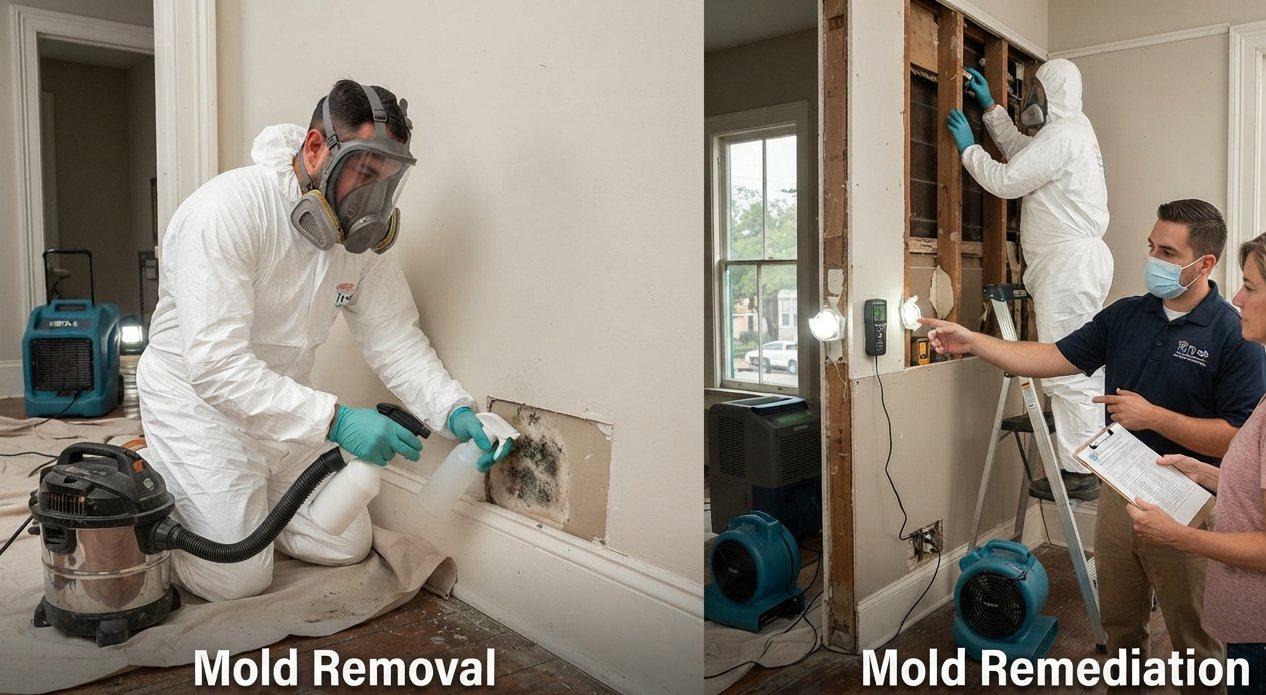
A dark patch near a baseboard, a musty room after heavy rain, and wet drywall beneath a leaking roof may all be described as “mold problems,” but they do not necessarily require the same response. When comparing mold removal vs. mold remediation in New Orleans, the most useful distinction is whether the work addresses only visible growth or the larger moisture condition allowing it to develop.
Removal may be one part of the job. Remediation is usually the broader process of identifying the affected area, controlling the work, removing or cleaning damaged materials, drying the structure, and reducing the chance that the same problem will return.
Quick Answer
- Mold removal generally refers to physically cleaning mold from surfaces or removing materials that cannot be cleaned adequately.
- Mold remediation is a broader process that also considers the moisture source, affected materials, containment, drying, and completion checks.
- Mold cleanup can describe an individual cleaning task without necessarily addressing hidden moisture or recurring growth.
- Water mitigation focuses on limiting additional water damage and drying wet materials, while restoration usually covers repairs and rebuilding.
- A small, accessible surface condition may require a different approach from mold inside walls, beneath flooring, in an attic, or under a raised home.
- The moisture source must be corrected. Cleaning the same spot repeatedly will not solve a continuing roof leak, plumbing leak, condensation issue, or drainage problem.
The Short Answer: Removal and Remediation Are Not Quite the Same
Mold removal and mold remediation overlap, but they are not always interchangeable. Removal describes getting mold or mold-damaged material out of a property; remediation describes bringing the entire mold and moisture condition under control.
What mold removal usually means
Mold removal usually means cleaning visible growth from a surface or taking out material that has been affected beyond practical cleaning. A contractor might clean mold from accessible framing, remove a section of damaged drywall, discard wet insulation, or remove carpet and padding that remained damp.
The phrase does not automatically explain what happens before or after that work. A removal estimate may or may not include moisture investigation, containment, drying, verification, or reconstruction, which is why the written scope matters more than the service label.
What mold remediation usually means
Mold remediation is normally a more complete process. It considers why the mold developed, how far the affected area may extend, which materials can remain, how the work area should be controlled, and what conditions should be met before the project is considered complete.
The goal is not to create a completely mold-free building—mold spores naturally exist indoors and outdoors. The practical goal is to correct the moisture problem, remove mold-damaged materials where necessary, clean salvageable surfaces, dry the area, and return the property to an acceptable condition. EPA guidance emphasizes that the moisture problem must be fixed before remediation can be considered complete.
Where mold cleanup fits
Mold cleanup describes the hands-on cleaning portion of the work. It may include detergent cleaning, HEPA vacuuming where appropriate, wiping surfaces, bagging debris, or removing materials that cannot be salvaged.
Cleanup can be sufficient for a limited condition on an accessible hard surface when the moisture source has already been corrected. It is less likely to be a complete solution when mold is recurring, concealed, spread across several materials, or connected to continuing water intrusion.
Why companies sometimes use the terms interchangeably
There is no universal marketing vocabulary used by every mold company. One business may call a project “mold removal,” while another describes almost identical work as “mold remediation,” “mold treatment,” “mold abatement,” or “mold cleanup.”
Instead of choosing a company based on terminology alone, ask what the proposed work includes. The scope should identify the affected area, moisture source, materials to be cleaned or removed, drying plan, work-area controls, exclusions, and completion criteria.
Why the Difference Matters in a New Orleans Property
The difference matters because New Orleans properties can develop moisture problems through several overlapping routes. A small bathroom surface issue is not the same as damp insulation after a roof leak, condensation around HVAC equipment, or recurring mold beneath a raised home.
A visible bathroom patch
A limited patch on tile, sealed grout, glass, or another hard surface may be a surface-cleaning issue, particularly when the source is ordinary condensation and the area can dry between uses. Cleaning still needs to be paired with better moisture control, such as effective ventilation and repair of any plumbing leak.
The situation changes when the wallboard is soft, paint is bubbling, the vanity base is swollen, or the growth returns soon after cleaning. Those clues suggest that moisture may be entering or remaining inside the material rather than sitting only on the surface.
A musty room with no visible growth
A persistent odor without visible growth is usually an inspection problem before it is a removal problem. The source may be behind a cabinet, beneath flooring, above a ceiling, inside an HVAC-adjacent cavity, or below the room in a crawl space.
When no growth is visible, the first useful step may be to trace a recurring musty smell back to the room, weather pattern, or building system connected to it. Opening walls or ordering random samples before tracing those clues can add expense without answering the main question.
Wet drywall after a roof or plumbing leak
Wet drywall requires prompt moisture assessment and drying decisions. The visible face may appear normal while the paper backing, insulation, framing, or enclosed cavity remains damp.
EPA and CDC guidance generally recommends drying wet materials as quickly as practical, ideally within approximately 24 to 48 hours when conditions allow. Porous materials that become moldy can be difficult or impossible to clean completely and may need to be removed.
Recurring growth caused by an unresolved moisture source
When mold returns after repeated cleaning, the unresolved source is usually the central issue. Possibilities include a slow plumbing leak, wind-driven rain, failed flashing, condensation on cold ducts, a blocked condensate line, poor drainage, or materials that were covered before they dried.
Repeated surface treatment may temporarily improve appearance, but it will not stop mold growth if the material continues to become damp.
What Mold Removal Usually Includes
Mold removal usually includes cleaning accessible hard surfaces and taking out porous materials that cannot be adequately cleaned or dried. The exact work should reflect the material, extent of growth, moisture source, access, and likelihood of disturbing mold into occupied areas.
Cleaning hard, nonporous surfaces
Hard, nonporous surfaces can often be cleaned with detergent and water and then dried completely. Examples may include glass, metal, some sealed tile, and certain intact hard finishes.
Cleaning methods should match the material and condition. Routine use of strong biocides is not the central solution to a mold problem, and EPA does not recommend biocides such as chlorine bleach as a routine mold-remediation practice.
Removing damaged porous materials
Drywall, ceiling tiles, carpet padding, insulation, and other porous materials can absorb moisture below the visible surface. Mold may grow within their pores and layers, making complete cleaning difficult.
Removal is more likely when the material has deteriorated, remained wet, developed extensive growth, or cannot be dried without opening the assembly. The decision should be based on condition and cleanability—not color alone.
Drying the immediate work area
Removal is incomplete if adjacent framing, subflooring, insulation, or wall cavities remain damp. Moisture readings and physical inspection may be needed before new drywall, flooring, cabinets, or insulation are installed.
Fans and dehumidification may be appropriate in some clean-water situations, but equipment should not be used in ways that spread contamination from a moldy area into clean rooms. Floodwater, sewage, electrical hazards, and extensive contamination require additional precautions.
Why simple removal does not solve the original problem
Removing a moldy section of drywall does not repair failed flashing above it. Cleaning joists does not redirect water collecting beneath a raised home. Replacing insulation does not stop an uninsulated duct from sweating.
Simple removal falls short when the project treats damaged materials but leaves the moisture path unchanged. That is usually the real issue.
What a Mold Remediation Project Usually Includes
A mold remediation project normally combines moisture correction, controlled removal, cleaning, drying, and completion checks. Larger, hidden, recurring, or multi-room conditions generally require more planning than isolated surface cleanup.
Finding and documenting the moisture source
The first question is not simply “Where is the mold?” It is “What allowed this material to remain damp?”
Useful documentation may include moisture staining, leak history, photographs, weather patterns, plumbing locations, HVAC operation, drainage conditions, and moisture measurements. The source might require a roofer, plumber, HVAC contractor, drainage specialist, or building repair contractor in addition to the remediation team.
Defining the affected area
Visible mold does not always show the full boundary of the condition. Dampness may extend behind baseboards, beneath flooring, above ceilings, inside cabinets, or along insulation.
Defining the area does not mean opening every wall. It means using the history of the water event, visible changes, odor patterns, material condition, access points, and appropriate measurements to create a reasonable work boundary.
Containment and air-control decisions
Containment is intended to reduce the movement of dust, debris, and mold from the work area into surrounding spaces. The level of control depends on the amount and condition of affected material, the work methods, occupancy, airflow, HVAC connections, and the potential for disturbance.
A tiny accessible surface condition may not require the same setup as demolition inside an occupied office or removal of mold-damaged drywall across several rooms. EPA guidance recommends adapting containment and protective measures to the project rather than treating every condition identically.
Removing materials that cannot be cleaned
Porous materials that are deteriorated, heavily affected, or difficult to dry may need to be removed. Materials selected for removal should be listed clearly in the scope so the owner understands what will remain and what must later be rebuilt.
Unexpected conditions can appear after finishes are opened. A useful estimate explains how discoveries such as wet insulation, hidden cabinet damage, or wider staining will be documented and approved.
Cleaning, drying, and checking the completed work
Completion is not based only on whether the wall looks cleaner. EPA guidance indicates that the moisture source should be corrected, visible mold and moldy odors should no longer be present, and cleaned materials should be dry before remediation is treated as finished. Depending on the project, evaluation may involve visual inspection, moisture measurements, review of the completed scope, and sometimes planned verification testing. Testing should answer a defined question rather than being added automatically.
How Mold Cleanup, Mitigation, and Restoration Fit Into the Picture
Cleanup, mitigation, remediation, and restoration describe different parts of a property-damage response. A single project may involve all four, but they should not be assumed to mean the same thing.
Cleanup as a task rather than a complete diagnosis
Cleanup is the physical act of removing dirt, residue, visible mold, or affected debris. It can be an appropriate standalone task when the condition is limited and the moisture problem has already been corrected.
It is not a complete diagnosis of why the material became damp or whether concealed areas are affected.
Mitigation as an attempt to limit additional damage
Water mitigation usually begins while materials are still wet. It can include stopping water entry, extracting water, moving contents, opening materials where appropriate, and beginning controlled drying.
Mold mitigation may also describe temporary measures intended to limit spread or exposure before the full remediation scope is completed.
Restoration as repair after cleanup and drying
Restoration is the repair or replacement stage. It may include installing drywall, insulation, flooring, trim, cabinetry, paint, or other finishes after affected materials have been removed and the underlying area has dried.
A company offering mold remediation may not perform all reconstruction work. That is not automatically a problem, but responsibilities should be clear before demolition begins.
Why reconstruction may be a separate scope of work
Keeping remediation and reconstruction separate can make the project easier to understand. The first scope addresses moisture, damaged materials, cleaning, and drying; the second returns the space to its finished condition.
This separation also makes it easier to see whether two estimates truly cover the same work.
Match the Service to the Clue You Have
Choose the service based on the evidence available now—not the most dramatic service name. Visible material condition, odor, leak history, active moisture, recurrence, access, and documentation needs should guide the first step.
You can see a small patch on a hard surface
A limited patch on a cleanable hard surface may call for careful cleaning and moisture correction rather than a large remediation project. Check for leaking supply lines, failed seals, condensation, and inadequate exhaust before treating it as only a cosmetic issue.
People with sensitivities or respiratory concerns may want to avoid disturbing visible mold and consult a qualified healthcare professional about personal health questions.
The odor returns but the source is hidden
Choose an inspection-oriented approach when a musty odor returns but no affected material is visible. Track whether it follows rain, AC operation, plumbing use, or long periods with the room closed.
Sampling may not locate the source. A moisture-focused inspection is often more useful at the beginning.
Materials stayed wet after a leak
Wet materials need drying and damage assessment before the project is labeled as simple mold removal. Materials that are still wet need a different response, so begin with what to do after a leak or storm before focusing only on visible growth.
After contaminated floodwater or sewage, avoid treating the condition like an ordinary clean-water leak. Flood cleanup can involve electrical, structural, biological, and chemical hazards in addition to mold.
Growth keeps returning after cleaning
Recurring growth points to recurring moisture, incomplete drying, hidden affected material, or all three. Remediation becomes more appropriate when the source is concealed, several materials are involved, or repeated surface cleaning has failed.
You need documentation for a property transaction or managed building
An inspection, written findings, moisture documentation, or specifically planned sampling may be useful when a buyer, seller, landlord, property manager, commercial tenant, consultant, or other decision-maker needs a record.
Managed properties often require consistent reporting, defined responsibilities, communication with occupants, and clear reopening criteria. A more formal commercial mold response plan can help keep those decisions organized.
Why the Moisture Source Changes the Entire Job
The source determines which contractor is needed, what materials must be opened, how drying should proceed, and whether mold is likely to return. Remediation without source correction is an incomplete repair.
Roof and flashing leaks
Ceiling discoloration that changes after rain may point to roofing, flashing, vent penetration, valley, or exterior-envelope problems. The affected drywall may be several feet away from the actual entry point because water can travel along framing.
Ceiling stains and roof-related odors can also point to signs of attic mold in a New Orleans home.
Plumbing and appliance leaks
Supply lines, drain connections, shower assemblies, refrigerators, washing machines, water heaters, and sink cabinets can release water into concealed spaces. A small slow leak may create more hidden material damage than a brief spill that is found immediately.
The plumbing repair and the material cleanup are separate tasks, although they should be coordinated.
AC condensation and duct issues
Condensation can develop around cold ducts, air handlers, drain pans, refrigerant lines, and supply registers when humid air reaches a cold surface. A clogged drain, damaged insulation, air leakage, or equipment issue may contribute.
Cleaning discoloration around a vent without checking the condensation pattern can lead to repeated staining.
Indoor humidity and closed rooms
High indoor humidity can keep closets, cabinets, bathrooms, and poorly ventilated rooms damp even without a dramatic leak. The response may involve ventilation, dehumidification, HVAC evaluation, air sealing, or changes in how the room is used.
Humidity alone should not be blamed until roof, plumbing, drainage, and condensation sources have also been considered.
Storm or flood moisture
Storm-related water can enter through roofing, windows, doors, exterior walls, or low areas of a building. Floodwater can also carry contaminants that change the safety requirements and determine which materials can be retained.
After a major water event, document the original water path before cleanup where it is safe to do so. FEMA recommends documenting damage and beginning safe cleanup promptly rather than waiting for mold to spread.
Drainage and crawl-space moisture
Water beneath a raised home may come from plumbing, runoff, poor drainage, periodic flooding, duct condensation, or damp soil. The odor or humidity may then affect rooms above even when no indoor spill occurred.
For raised properties, the real source may be crawl-space moisture in raised New Orleans homes rather than a spill inside the room.
When an Inspection or Mold Testing Should Come First
Inspection should generally come first when the source, extent, or affected materials are unclear. Testing may be useful when it answers a specific documentation or verification question, but it is not automatically required before visible mold is cleaned or removed.
It helps to understand why mold inspection and mold testing serve different purposes before ordering samples.
When the source is not visible
An inspection can connect odor, staining, moisture readings, leak history, HVAC conditions, and building layout. The goal is to develop a reasonable explanation of where the moisture originates and which areas deserve closer examination.
When multiple rooms may be involved
Multiple rooms can be connected by the same roof section, plumbing line, crawl space, HVAC system, or past water event. A coordinated inspection is more useful than treating each mark as an unrelated surface problem.
When documentation is required
Testing or detailed reporting may be considered for a property transaction, defined commercial protocol, dispute, consultant-led project, or post-remediation verification plan. The test should have a stated purpose, planned locations, and someone qualified to interpret the results.
When testing may add little useful information
EPA and Louisiana Department of Health guidance state that sampling is generally unnecessary when visible mold is already present. There are no federal threshold limits for airborne mold concentrations that turn a sample result into a simple pass-or-fail answer, and LDH recommends correcting visible or detectable moisture problems rather than testing merely to identify mold by name.
Questions to Ask Before Approving a Scope of Work
A useful scope should explain the moisture problem, affected materials, work controls, drying, exclusions, and completion criteria. Use a written checklist to choose a mold remediation company in New Orleans instead of comparing companies by headline promises alone.
What moisture source was identified?
Ask whether the source is confirmed, suspected, repaired, or still under investigation. If another trade must repair it, clarify when that work will occur relative to remediation.
Which materials will be cleaned and which will be removed?
The scope should identify drywall, insulation, flooring, cabinets, framing, ceiling materials, trim, or contents affected by the work. It should also explain what may change after concealed areas are opened.
Is drying included?
Confirm whether drying equipment, moisture measurements, monitoring visits, and final readings are included. Removing visible material while leaving the cavity damp can delay reconstruction and allow the condition to continue.
Is reconstruction included?
Ask whether the price includes replacement drywall, insulation, trim, flooring, cabinets, texture, and paint. “Restoration” in a company name does not guarantee that every rebuilding task is included in the quoted scope.
How will completion be evaluated?
Completion may involve a visual assessment, confirmation that the moisture source was addressed, moisture readings, absence of visible debris and moldy odor, and any agreed verification procedure. Make sure the standard is established before work begins.
Common Mistakes That Allow the Problem to Return
Mold commonly returns when the project improves appearance but leaves damp material, hidden damage, or an unresolved water path. The repair sequence matters: stop the moisture, define the affected area, clean or remove damaged material, dry the assembly, and rebuild only when conditions are ready.
Painting over staining
Paint can conceal discoloration for a while, but it does not remove mold or dry the substrate. CDC guidance specifically warns against painting or caulking over mold before correcting the water problem and completing cleanup.
Masking odor without finding moisture
Fragrance, fogging, or surface deodorizing may reduce odor temporarily without identifying damp insulation, wet cabinet bases, crawl-space moisture, or an HVAC condensation problem.
A returning odor is evidence that the investigation is not finished.
Replacing drywall before the cavity is dry
New drywall can hide wet framing, insulation, masonry, or subflooring. Before closing the cavity, confirm that the leak has been repaired and retained materials have dried adequately.
Assuming every dark mark is “toxic black mold”
Color does not identify mold species or determine the necessary scope. Louisiana Department of Health notes that black is a color, not a type of mold, and not every black-colored mold is Stachybotrys. Color alone does not identify the species, so read what dark or black mold actually tells you before drawing conclusions from appearance.
Comparing estimates that include different scopes
One estimate may cover demolition and cleaning, while another includes containment, equipment, drying, testing, disposal, and rebuilding. Comparing only the total price can therefore be misleading.
Two quotes can look very different because the factors behind a mold remediation estimate include access, materials, containment, drying, and reconstruction.
What Trusted Public Health and Cleanup Guidance Emphasizes
Public guidance consistently treats mold as a moisture-control and material-cleanup problem rather than a matter of simply applying a chemical product.
- Identify and correct the water source. Roof, plumbing, condensation, drainage, and flood-related moisture must be addressed for cleanup to remain effective.
- Dry wet materials promptly. EPA and CDC guidance commonly uses a 24-to-48-hour target where safe and practical, although actual drying depends on the material and conditions.
- Clean hard surfaces and evaluate porous materials carefully. Mold can penetrate porous materials, making some items difficult to clean completely.
- Use appropriate protective measures. Gloves, eye protection, respiratory protection, work-area controls, and additional help may be appropriate depending on the size and complexity of the condition.
- Do not cover mold with paint or caulk. Clean the affected area and correct the moisture problem before refinishing.
- Seek qualified assistance for larger, hidden, contaminated, or complex conditions. This is especially relevant after floodwater, sewage, extensive demolition, HVAC contamination, or water affecting electrical and structural components.
A Simple New Orleans Mold Service Decision Tree
Start with the clue you have and choose the next step that answers the most immediate question. Do not select a service only because its name sounds more comprehensive.
Start with what you can see, smell, and trace
Record the room, material, odor, discoloration, leak history, weather pattern, and whether the area is still damp. Note whether the condition changes after rain, plumbing use, AC operation, or periods when the room stays closed.
Choose inspection when the source is unclear
Inspection makes sense when you smell mold but cannot see it, staining appears in several places, the condition returns, or the building history suggests hidden moisture.
The objective is to identify likely sources and affected materials—not merely confirm that mold spores exist in the environment.
Choose drying when materials are still wet
Active water damage takes priority. Stop or isolate the source where safe, assess the type of water involved, remove standing water, and begin an appropriate drying plan.
Do not rebuild over wet materials simply because mold is not yet visible.
Choose remediation when the problem is recurring, hidden, or extensive
Remediation is the better framework when the condition involves concealed cavities, several materials, recurring growth, extensive water damage, occupied commercial areas, difficult access, or a meaningful risk of spreading debris during removal.
The project may still include straightforward removal and cleaning. The difference is that those tasks are managed as part of a complete moisture-and-material plan.
Frequently Asked Questions
Is mold remediation more extensive than mold removal?
Usually, yes. Mold removal focuses on cleaning or taking out affected material, while remediation normally includes source identification, work-area controls, removal, cleaning, drying, and completion evaluation. The exact meaning still depends on the written scope provided by the company.
Can mold be removed without fixing the leak?
Mold can be physically cleaned or removed while a leak remains, but the result is unlikely to last if materials continue getting wet. EPA guidance treats correction of the water or moisture problem as a necessary part of completing cleanup or remediation.
Does every mold problem require containment?
No. Containment decisions depend on the amount and condition of affected material, the work method, occupancy, airflow, HVAC connections, and the likelihood of spreading dust or mold into clean areas. More extensive or disruptive work generally calls for stronger controls than a limited surface-cleaning task.
Is mold cleanup the same as water-damage restoration?
No. Mold cleanup addresses mold and affected material, while water-damage restoration may include extraction, drying, demolition, repairs, and reconstruction after a leak or flood. A project can involve both services, but they may appear as separate scopes or be handled by different trades.
Should I test mold before having it removed?
Testing is usually unnecessary when mold is already visible and the practical response will not change based on the species name. Sampling may make sense when the source is unclear, documentation is required, or a planned verification process calls for it.
Editorial Note
The most reliable way to think about mold removal versus remediation is to follow the moisture. A visible patch may be only a surface condition, or it may be the accessible edge of wet material behind a wall, beneath a floor, above a ceiling, or under a raised home. Property conditions, safety concerns, and the extent of water damage should determine the response—not color, odor alone, or a service label.
This article provides general property-care information and is not medical, engineering, legal, insurance, or policy-coverage advice. If you have health concerns, consult a qualified healthcare professional. Review project-specific conditions with appropriate property, remediation, or building professionals before disturbing extensive visible mold or flood-damaged materials.
Discuss a Mold or Moisture Concern
If you have noticed persistent moisture, staining, a returning musty odor, or visible mold in a New Orleans property, call New Orleans Mold Fix at (504) 520-4589 to discuss the affected area, what may have caused it, and the most practical next step.