You open a closet, step into a back bedroom, or hear the AC start—and that damp, stale odor returns. If you are asking, “Why does my New Orleans house smell musty?” the most useful answer is not simply “mold.” A musty smell is a clue that moisture may be lingering somewhere, but finding when and where the odor appears is what leads you toward the actual source.
In New Orleans properties, that source might be a small plumbing leak, rain entering near flashing, condensation around HVAC components, damp material under a raised home, or part of a wall or ceiling that never fully dried after a storm. The goal is to follow the moisture story before covering the smell or cleaning the same surface again.
Quick Answer
- A musty smell usually points to damp materials, poor drying, limited airflow, or possible mold growth, but odor alone cannot identify the source.
- If the smell becomes stronger after rain, check roof lines, flashing, ceilings, windows, exterior walls, and crawl-space drainage.
- If it appears when the AC runs, inspect the air handler area, condensate drain, drip pan, return space, ducts, and nearby insulation.
- If one cabinet, closet, or room smells damp, inspect the surfaces beside, above, below, and behind it.
- Wet materials should be dried promptly because moisture trapped inside drywall, insulation, flooring, or cabinets can remain after the visible surface looks dry.
- Fragrance, fresh paint, and random air samples do not repair a leak, clogged drain line, damp crawl space, or hidden water intrusion.
The Short Answer: A Musty Smell Usually Points to Persistent Moisture
A musty odor usually means that a material or enclosed area has stayed damp long enough to develop an earthy or stale smell. Mold may be involved, but odor can also come from wet wood, damp drywall paper, old carpet padding, deteriorating cabinet material, or debris in a humid space with limited airflow.
The important question is not only whether mold is present. It is why the material became damp, whether the moisture source is still active, and whether affected areas can dry properly.
Why odor can appear before visible growth
Odor can travel through cracks, wall penetrations, cabinet openings, floor gaps, duct pathways, and other small air routes. You may smell a concealed damp area before discoloration becomes visible on the finished surface.
For example, a sink cabinet may look dry from the front while the back panel, wall cavity, or cabinet base remains damp. A ceiling may show no obvious mold even though wet insulation or roof decking above it is producing an odor. The absence of visible growth does not rule out a hidden moisture problem.
Why airing out the room may only hide the clue temporarily
Opening windows or running a fan can dilute an odor, but it does not remove water trapped behind drywall, beneath flooring, inside a cabinet base, or around insulation. When the room is closed again, the smell may slowly return.
Treat that return as useful information. Note how long the odor takes to come back, whether weather or AC operation affects it, and where it is strongest. Those patterns are often more useful than judging how strong the smell is on one particular day.
Start With the Timing of the Smell
The timing of a musty smell can help separate rain entry, HVAC condensation, plumbing moisture, indoor humidity, and old water damage. Before moving furniture or opening walls, keep a simple record for several days: when the odor appears, what the weather was doing, whether the AC was running, and which room smelled strongest.
| When the smell gets stronger | Possible moisture source | Useful first check |
|---|---|---|
| During or after rain | Roof, flashing, window, siding, drainage, or crawl-space moisture | Look for changing stains and dampness near exterior surfaces |
| When the AC starts | Air handler, condensate drain, drip pan, ducts, insulation, or return area | Note which vents smell and inspect accessible HVAC areas |
| After the house stays closed | Humid rooms, closets, cabinets, carpet, or limited airflow | Open enclosed spaces individually and compare odors |
| After showering or laundry | Exhaust, plumbing, condensation, or wet finishes | Check ventilation, water connections, drains, and adjacent walls |
| After a leak or storm | Incomplete drying inside materials or cavities | Trace everything that became wet, including hidden layers |
The smell gets stronger after rain
A house that smells musty after rain may have water entering through a roof detail, flashing joint, window opening, exterior wall, damaged seal, or another part of the building envelope. Surface water may also be collecting near the foundation or dampening the crawl space beneath a raised home.
Look for stains that darken, spread, or change shape during or shortly after rainfall. Check ceilings beneath roof valleys, walls near windows, baseboards along exterior walls, attic framing, and crawl-space areas where runoff may collect. A mark that changes with the weather deserves more attention than an old stain that remains stable.
The smell appears when the AC starts
When the odor begins only after the blower starts, moving air may be carrying smells from the air handler, return cavity, ductwork, damp insulation, or another connected space. This does not automatically mean mold is growing throughout the duct system.
Check whether the smell comes from every supply vent or only one section of the house. A whole-house odor may point toward the central equipment or return-air area. A smell from one vent may be connected to a localized duct, wall cavity, ceiling space, or room condition.
The smell is worse after the house has been closed
A closed house gives moisture and odor fewer ways to disperse. Closets packed tightly against exterior walls, guest rooms with closed doors, cabinets that rarely open, and storage areas with limited airflow can develop a noticeably stale smell.
Open one area at a time instead of opening every door and cabinet at once. This makes it easier to identify whether the odor is concentrated inside a specific closet, cabinet, bedroom, piece of furniture, or section of wall.
The smell changes after showering or cooking
Showers, boiling water, dishwashing, and clothes drying release moisture indoors. If an exhaust fan is weak, disconnected, dirty, or not venting outdoors, that moisture can remain in the room and collect on cooler surfaces.
Pay attention to bathroom ceilings, laundry-room walls, window frames, cabinets, nearby closets, and the wall behind major appliances. A smell that appears after water use may indicate poor ventilation, condensation, a drain problem, or a slow supply-line leak.
The smell began after a leak, storm, or repair
An odor that started after a known water event should be traced back to every material that became wet, not only the finished surface that was repaired. Dry paint or new drywall can conceal damp insulation, framing, subflooring, or cabinet material.
When the odor began after a recent water event, review the first steps after water enters a New Orleans property. A repair is not complete merely because the visible leak has stopped. The affected assembly also needs enough access, airflow, and drying time.
Follow the Odor Room by Room
The room where you notice the smell is not always where the moisture begins. Odor can move from an attic, crawl space, return-air pathway, wall cavity, or adjacent cabinet, so inspect nearby building components as well as the room itself.
Closets and closed bedrooms
A mold smell in a closet often becomes stronger on shoes, cardboard, fabric, or items stored against a cool wall. Remove enough belongings to inspect the baseboards, back wall, ceiling corners, shelving, and flooring.
An exterior-wall closet may be affected by rain entry, condensation, or reduced airflow behind stored items. A closet below a bathroom, attic, or roof valley may instead be receiving moisture from above. Avoid pushing storage tightly back into place until the source is clearer.
Kitchen cabinets and sink bases
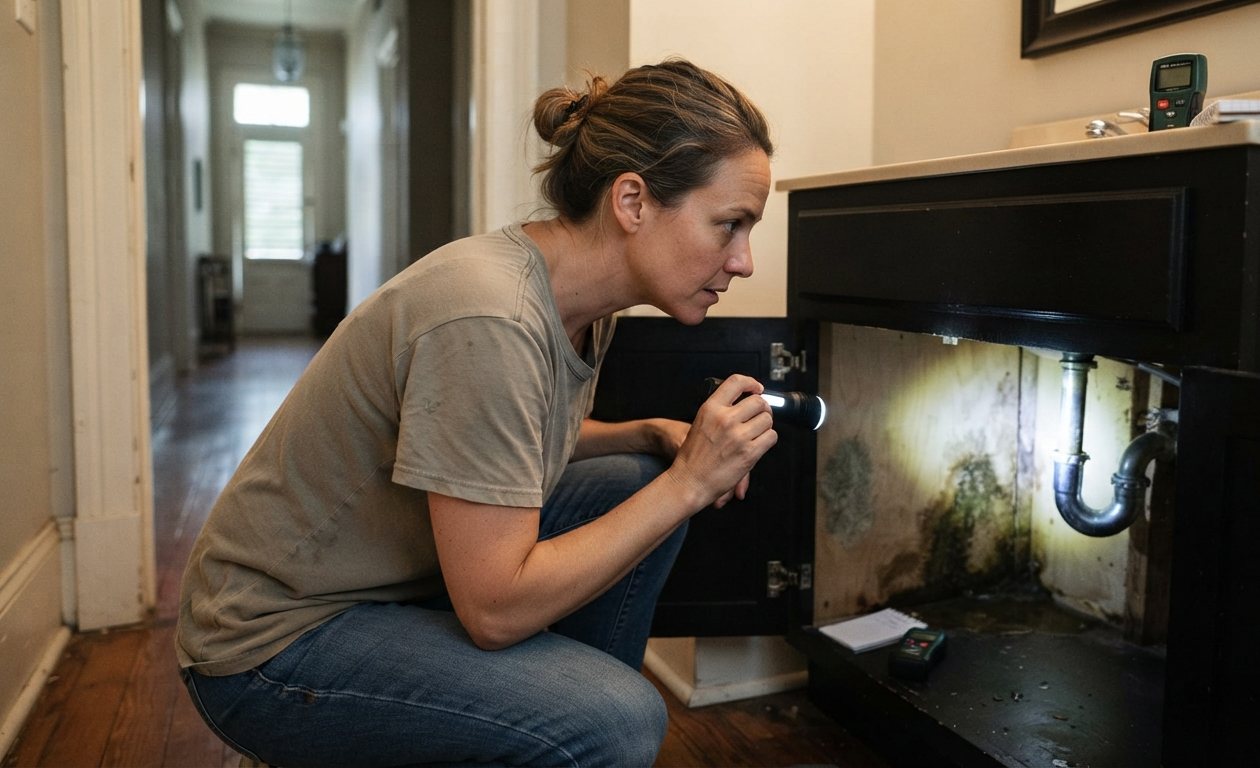
Musty cabinets in New Orleans humidity deserve a plumbing check before any odor treatment. Inspect shutoff valves, supply lines, the drain assembly, garbage-disposal connections, dishwasher hoses, and the cabinet floor.
Run a dry paper towel around accessible connections to reveal slow seepage. Inspect the wall behind plumbing openings and the toe-kick area below the cabinet. Water can move beneath a cabinet base and affect particleboard, flooring, or drywall before a visible puddle develops.
Bathrooms and laundry rooms
Bathrooms and laundry rooms combine water supply, drainage, warm air, and frequent humidity. Check around toilets, tubs, shower enclosures, washing-machine hoses, drain connections, exhaust fans, and baseboards.
A repeated odor after showering may indicate that moisture is not leaving the room efficiently. A smell that remains when the room has not been used may point toward a concealed plumbing leak or building material that was previously soaked and never dried fully.
Rooms below an attic or roof valley
A musty smell near an upstairs ceiling can begin with roof leakage, wind-driven rain, damp insulation, condensation, or limited attic ventilation. Inspect for yellow-brown rings, peeling paint, softened drywall, and stains that change after rain.
A smell near an upstairs ceiling may justify checking for attic mold and roof-moisture clues. Attics are easy to overlook, which allows roof, duct, insulation, or condensation problems to continue before the signs become obvious inside the living space.
First-floor rooms over a crawl space
In a raised New Orleans home, a musty smell close to the floor may be coming from damp soil, standing water, leaking pipes, wet insulation, sweating ducts, or affected wood beneath the first floor. Gaps around plumbing, wiring, flooring, and baseboards can allow crawl-space air to move upward.
If the odor is strongest near the floor, investigate mold and moisture beneath a raised home. Check whether the smell becomes stronger after rain, whether water collects under the building, and whether insulation or duct surfaces appear damp.
Areas near an air handler, supply vent, or return
A return grille can pull air from nearby gaps, utility closets, attics, or wall cavities. An air handler can also develop moisture problems if the pan, drain line, insulation, or nearby materials remain wet.
Look for rust, water marks, damp insulation, debris around the drain route, and discoloration near the equipment. Do not open electrical or sealed HVAC components unless you are qualified to do so.
Look for Moisture Clues, Not Just Mold Spots
The most useful clues are changes in building materials: swelling, softness, staining, peeling, corrosion, condensation, or recurring dampness. Visible mold is only one possible sign of a moisture problem.
Bubbling or peeling paint
Paint can bubble when moisture moves through or remains behind the painted surface. The visible defect may be several inches away from the original entry point because water can travel along framing, plaster, drywall paper, or trim.
Do not scrape and repaint before determining whether the material is dry. A fresh coat of paint will not solve an active leak or concealed dampness.
Water stains that change after rain
An old, stable stain and an active leak require different responses. Photograph the area from the same position before and after rainfall, using a nearby edge or ruler for scale.
If the stain darkens, expands, or feels cooler or softer, the moisture pathway may still be active. Check the roof or exterior area above it rather than treating the stain as an isolated cosmetic problem.
Warped trim, cabinets, or flooring
Swollen cabinet edges, separated flooring, cupped boards, and warped baseboards often indicate that a porous material absorbed moisture. The surface may later feel dry while the layer beneath it remains affected.
Inspect both sides where possible. Flooring near an exterior door may point to rain entry, while swelling beside a sink, toilet, washing machine, dishwasher, or refrigerator may suggest plumbing or appliance moisture.
Condensation on ducts, pipes, windows, or vents
Condensation forms when warm, humid air meets a cold surface. Repeated condensation can wet insulation, ceiling material, wood, drywall, or nearby dust.
A few droplets on an unusually humid day are different from insulation that stays damp or water that repeatedly drips onto building materials. The frequency, amount, and destination of the water matter.
Soft drywall or swollen baseboards
Drywall that feels soft, crumbly, swollen, or unusually cool may have absorbed water. Baseboards can also conceal damage along the bottom edge of a wall, particularly after a plumbing leak or water moving across a floor.
Avoid pressing aggressively into visibly damaged material. If the wall is deteriorated, a controlled assessment may be more appropriate than opening it without containment or a plan.
Dark marks around supply registers
Dark marks at a vent are not automatically mold. They may be dust deposited by air movement, condensation staining, material deterioration, or microbial growth.
Check whether the register feels wet, whether nearby insulation is damp, and whether the mark wipes away like dry dust. If moisture is present or the discoloration quickly returns, investigate condensation, air leakage, or nearby damp materials.
Common New Orleans Sources of a Musty Odor
In New Orleans, the most practical starting points are roof and flashing conditions, HVAC condensate, plumbing connections, raised-home crawl spaces, enclosed rooms, and materials affected by earlier storms. These sources reflect common ways water can enter or remain trapped in local buildings, but they do not mean every property has the same problem.
Roof and flashing leaks
Roof leaks often begin at joints: flashing around vents or chimneys, roof valleys, edges, penetrations, and transitions between materials. Wind-driven rain can expose weaknesses that may not leak during a lighter shower.
The stain may appear in a different location from the roof opening because water can follow framing or decking before reaching the ceiling. Inspect the underside of the roof, insulation, rafters, and ceiling areas beneath likely entry points.
AC drain and condensation problems
Air-conditioning systems remove moisture from indoor air, which produces condensate that must drain away correctly. A blocked drain, damaged pan, uninsulated cold surface, or wet mechanical closet can create odor even while the system continues cooling.
Look for water marks below the equipment, recurring moisture in the pan, debris near accessible drain openings, and damp material around ducts. Electrical, refrigerant, and mechanical repairs should be handled by an HVAC technician.
Plumbing leaks inside cabinets or walls
Slow plumbing leaks can continue for weeks without producing a dramatic puddle. Water may soak into the rear of a cabinet, bottom plate of a wall, subfloor, drywall, or insulation.
Listen for dripping after fixtures are turned off and check accessible connections with dry paper. A plumber may be needed to identify and repair the source. Mold cleanup addresses affected materials, not the failed pipe or drain connection.
Damp crawl spaces beneath raised homes
Water beneath a raised home can come from drainage, periodic flooding, plumbing, condensate discharge, or condensation on cold ducts and pipes. Damp soil and wet insulation can maintain an odor even when rooms above appear clean.
The correction depends on the source. Cleaning one floor register or adding fragrance upstairs will not redirect rainwater, repair a pipe, or dry damaged insulation beneath the house.
Humid closets and rooms with limited airflow
A closed room can retain humidity and develop cooler surfaces where moisture collects. Furniture pressed against walls, crowded shelving, and closed closet doors further reduce air movement.
Create space around stored items and inspect the wall, floor, and ceiling. Better airflow may help, but recurring staining or damp building materials still require source tracing.
Materials that were never completely dried after a storm
After tropical storms, hurricanes, roof damage, or wind-driven rain, water can remain in insulation, wall cavities, flooring layers, and cabinet bases. A surface may appear dry while deeper layers remain damp.
If the event happened months ago, the useful question is which materials became wet, what was removed or replaced, and whether the original moisture source was fully corrected. Previous storm damage should remain part of the property’s moisture history.
When the Smell May Come From the HVAC System
An HVAC-related odor usually follows air movement: it begins when the blower starts, is strongest at particular vents, or concentrates near the air handler or return. The source may be the equipment itself, but it can also be a damp attic, closet, crawl space, or wall cavity connected to the airflow pathway.
Why the odor starts only when air moves
The blower can distribute an odor that was previously confined. A leaky return pathway may draw air from an equipment closet or building cavity, while a supply duct may carry odor from damp insulation near one branch.
Map the vents. Note which one smells first and whether the odor fades after several minutes or continues throughout the cooling cycle.
Air handler and condensate clues
Look for accessible signs such as standing water, rust, staining below the unit, a wet filter, or damp material near the condensate route. A partially blocked drain line can create intermittent moisture, which explains why the smell may come and go.
Do not remove electrical panels or reach into operating equipment. A visible drainage or equipment problem should be evaluated by an HVAC provider.
Duct insulation and sweating ducts
Cold ducts running through humid attics or crawl spaces may develop condensation when insulation is damaged, missing, compressed, or poorly sealed. That moisture can affect the insulation itself and nearby wood, drywall, or ceiling material.
The repair may involve both HVAC work and assessment of the building materials that became wet. Replacing insulation without addressing the condensation condition may allow the problem to return.
Why an HVAC call and a mold call may address different parts of the problem
An HVAC technician can diagnose mechanical operation, condensate drainage, airflow, and duct insulation. A mold or moisture assessment focuses on what became damp, how far the condition extends, and whether affected materials require cleaning, removal, or remediation.
Sometimes one provider identifies or repairs the source and another addresses the affected building materials. Those scopes should be clearly separated so the same work is not confused or duplicated.
What Not to Do With a Persistent Musty Smell
Do not treat a recurring odor as an air-freshening problem. Masking, painting, surface wiping, or unplanned testing can spend money without answering where the water came from or which materials remain damp.
Do not rely on fragrance or odor treatments
Sprays, candles, scented cleaning products, and odor treatments may temporarily cover the smell. They do not dry insulation, repair flashing, clear a condensate drain, or replace damaged porous material.
Strong fragrance can also make it harder to compare the odor between rooms and identify where it is strongest.
Do not paint over stains before tracing moisture
Paint can hide discoloration while leaving the underlying condition unresolved. The water source, affected material, and drying status should be evaluated before refinishing.
Document the stain first, determine whether it changes with weather or water use, and confirm that the surface and cavity are dry. A fresh coat of paint will not solve it.
Do not assume a clean surface means the cavity is dry
A wall can be wiped clean while insulation behind it remains damp. A cabinet may look normal above the shelf while its base is swollen underneath.
Consider the full assembly: the surface, backing material, cavity, adjacent framing, insulation, flooring, and the path the water may have followed.
Do not order random air samples without a clear question
Air sampling is not a universal first step for a musty smell. A test may identify particles collected during a short sampling period, but it does not automatically locate a leak, identify damp materials, or define the full extent of a concealed problem.
An inspection focused on moisture may provide more useful information than collecting samples before anyone has examined the roof, plumbing, HVAC system, attic, crawl space, or affected materials.
When a Mold Inspection Makes Sense
A mold inspection makes sense when the odor persists, the source is concealed, several areas are involved, or earlier repairs failed to stop the pattern. The purpose should be to connect the smell to moisture conditions and affected materials, not merely to confirm that mold particles can exist indoors.
Before ordering samples, decide whether you need an inspection or actual mold testing. An inspection and a laboratory test answer different questions.
The odor returns but no source is visible
A recurring smell without visible growth may justify moisture measurements and inspection of adjacent rooms, cabinets, attics, crawl spaces, and accessible cavities. The assessment should follow plausible water pathways rather than opening random surfaces.
More than one room is affected
Multiple rooms may share a roof section, plumbing line, return-air pathway, crawl space, exterior wall, or previous storm event. Map the odor by room and note which area smells strongest before airing out the property.
The smell follows rain or AC operation
A consistent weather or equipment pattern is valuable diagnostic evidence. It directs attention toward roof and exterior conditions, drainage, condensate, ducts, mechanical spaces, and hidden areas connected to airflow.
Previous repairs did not solve the problem
If a roof was patched, a pipe repaired, or drywall replaced but the smell returned, review the original scope. The repair may have stopped new water while leaving wet, damaged, or contaminated materials in place.
A renter or property manager needs documentation
Renters and property managers benefit from a dated record of the room, odor pattern, photographs, visible material changes, known leaks, prior work orders, and communications. Written documentation helps everyone discuss the same condition and distinguish an active water event from a historical stain or unresolved odor.
This information is general property-care guidance and is not legal or lease advice.
How to Describe the Problem During a Phone Call
A useful phone description includes location, timing, weather or HVAC patterns, previous water events, and visible changes in materials. You do not need to know whether the correct service is inspection, testing, cleanup, removal, or remediation before calling.
Once the likely source is clearer, it becomes easier to choose between cleanup, removal, and remediation.
Identify the room and nearest wall, roof, or plumbing fixture
Say where the odor is strongest and what is beside, above, and below that location. “Back bedroom closet below the roof valley” is more useful than “the entire house smells bad.”
Explain when the odor gets stronger
Mention rain, AC cycles, showering, cooking, closed doors, warm afternoons, or returning after a weekend away. Timing can quickly narrow the first areas that should be checked.
Mention previous leaks, storms, or repairs
Include approximate dates, affected rooms, what was repaired, and which materials were removed or dried. A leak from last year can still matter if the odor began at the same time.
Note visible stains and changes in materials
Describe peeling paint, swollen trim, soft drywall, warped flooring, condensation, or dark marks. Photographs taken before cleaning or painting can preserve useful context.
What Trusted Cleanup Guidance Emphasizes
- Find and correct the water source. Cleaning visible mold without repairing the moisture problem makes recurrence more likely.
- Dry wet materials promptly. Drying is especially important after leaks, spills, plumbing failures, roof damage, storms, and flooding.
- Do not simply cover damaged material with paint. The affected material and moisture condition should be addressed first.
- Use appropriate protection when disturbing visible mold. People with sensitivities or respiratory concerns may want to avoid disturbing affected materials.
- Use qualified help for extensive, concealed, hazardous, or technically complex conditions. Flood contamination, electrical hazards, structural damage, HVAC equipment, and large material-removal projects may require different specialists.
- Keep health questions separate from property assessment. If you have health concerns, consult a qualified healthcare professional.
Frequently Asked Questions
Can a house smell musty without having visible mold?
Yes. Odor can come from damp drywall, wood, insulation, carpet backing, cabinets, crawl-space material, or concealed mold growth that is not visible from the room. Trace the moisture source and inspect adjacent spaces rather than relying on appearance alone.
Why does my house smell musty only when it rains?
A rain-related odor often suggests moisture entering through roofing, flashing, windows, siding, exterior joints, or drainage near the foundation. In a raised New Orleans home, rainfall may also increase dampness beneath the first floor. Photograph changing stains and note how soon the odor appears after rain begins.
Why does the AC make the house smell moldy?
The blower may be moving odor from a wet air-handler area, condensate problem, damp duct insulation, return cavity, attic, or crawl space. Compare the smell at different vents and inspect accessible equipment areas for water marks or damp materials. Mechanical diagnosis should be handled by an HVAC technician.
Can a crawl space make the whole house smell musty?
Yes. Air and odor can move from a damp crawl space through gaps around plumbing, wiring, ducts, flooring, and wall assemblies. Look for drainage problems, plumbing leaks, wet insulation, sweating ducts, standing water, and affected floor framing.
Should I test the air if I smell mold?
Not automatically. Air testing is most useful when it is designed to answer a specific question, and a single sample does not identify the moisture source. Begin with a visual and moisture-focused inspection, then decide whether sampling would change the next step.
---
Editorial trust note: A musty smell is evidence worth investigating, but it is not a laboratory identification or a medical diagnosis. The practical sequence is to document the pattern, trace the water or humidity source, determine which materials became damp, and then select the appropriate cleanup or repair. Avoid disturbing extensive visible growth without suitable protection, and consult a qualified healthcare professional about personal health concerns. Recommendations depend on the actual property conditions.
Talk Through the Musty Odor
If a musty smell keeps returning in your New Orleans home, rental, or small business property, call New Orleans Mold Fix at (504) 520-4589 to describe the room, odor pattern, stains, previous leaks, and other moisture clues. You can discuss whether an assessment may help identify the affected area and practical next steps.