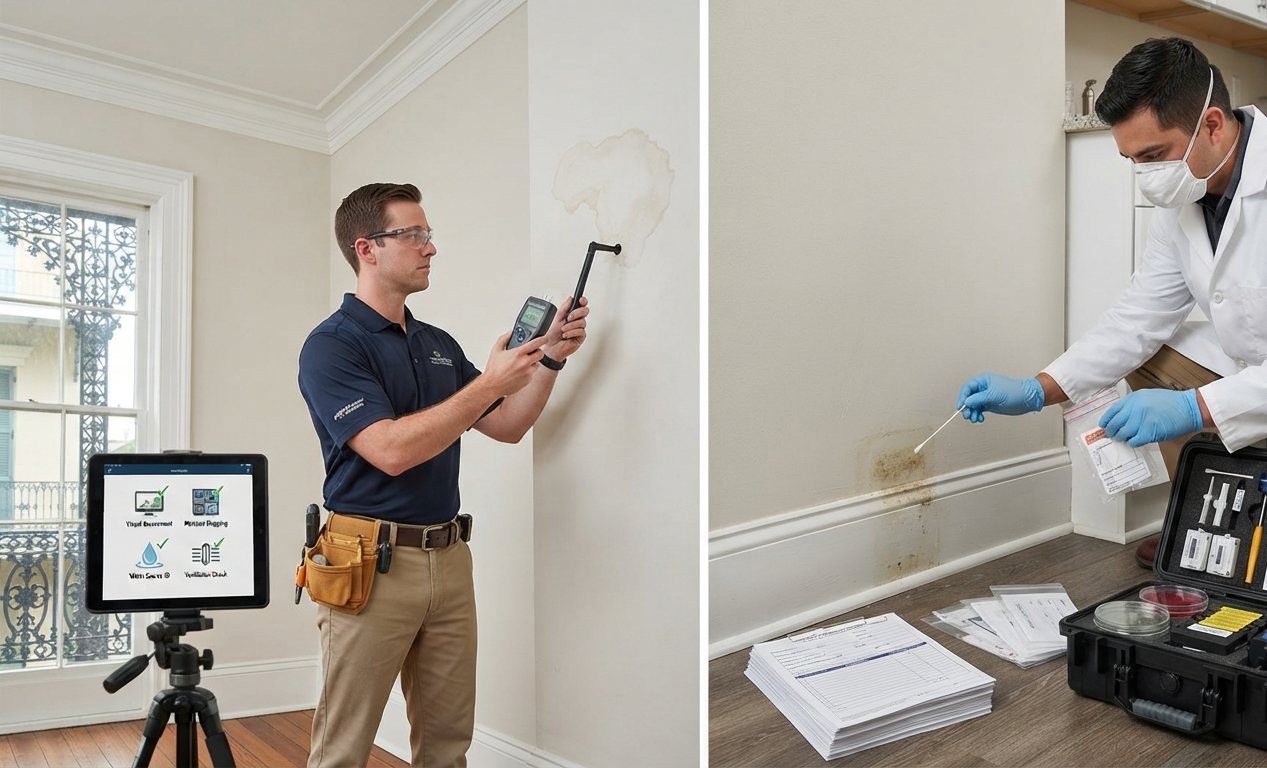
A musty odor that returns when the AC runs, ceiling staining after heavy rain, or discoloration behind a baseboard can leave a New Orleans property owner wondering whether to order an inspection, a mold test, or both. Mold inspection vs. mold testing in New Orleans comes down to purpose: inspection investigates the property and its moisture story, while testing collects samples to answer a narrower question.
Quick Answer
- A mold inspection looks for visible growth, water damage, moisture sources, material changes, odors, and possible hidden moisture.
- Mold testing collects air, surface, or material samples; it does not locate a leak or condensation source by itself.
- If mold is visible, testing is often unnecessary. The immediate questions are what became wet and what must be cleaned, dried, or removed.
- Testing may help with suspected hidden contamination, required protocols, transaction documentation, or agreed post-remediation verification.
- There are no federal or Louisiana health-based airborne-mold thresholds that create a simple “safe” or “unsafe” result. Every proposed sample should have a stated purpose and effect on the next decision.
The Short Comparison
A mold inspection examines building conditions and moisture sources; mold testing analyzes samples from the property. Inspection is usually the starting point because mold growth is connected to damp materials, water entry, humidity, or condensation. Testing can support that investigation, but it should not replace it.
An Inspection Looks for Conditions and Sources
An inspection connects the clue to a likely water pathway—for example, a roof leak above a ceiling stain, a damp sink cabinet, a wet crawl space, or condensation near HVAC components.
Testing Collects Samples for Laboratory Analysis
Testing may identify fungal material and report counts or relative concentrations. It can answer a defined question, but it does not reveal where water entered, whether materials remain damp, or what must be removed.
Testing Does Not Replace the Moisture Investigation
A sample is a snapshot under particular conditions. It cannot substitute for inspecting the roof, plumbing, HVAC system, attic, crawl space, flooring, walls, and cabinets. EPA and CDC/NIOSH emphasize visible conditions, odor, water history, and moisture over routine air sampling.
What a Mold Inspection Should Examine
A useful inspection treats the property as a moisture system. In New Orleans, that can involve roof or plumbing leaks, heavy rain, storm water intrusion, HVAC condensation, damp crawl spaces, humid closed rooms, and materials that never fully dried.
The History of Leaks and Water Events
Note when the stain or odor appeared, whether it changes after rain or AC use, and whether a roof leak, plumbing repair, appliance overflow, tropical storm, or flood cleanup came first. Older water events matter when materials may have been enclosed before drying.
Visible Staining and Material Changes
Peeling paint, swollen baseboards, warped flooring, soft drywall, discolored ceilings, rust near HVAC components, and expanded cabinet panels can all point to moisture. Louisiana Department of Health lists these material changes and musty odor among common warning signs.
Moisture Measurements
Moisture readings help compare a suspicious area with nearby material and map a possible water path. One number is not a diagnosis, but a pattern can reveal incomplete drying or an active source.
Attics, Crawl Spaces, Cabinets, and Wall Areas
The source may sit outside the room where the clue appears. EPA notes that concealed growth can occur behind finishes, beneath carpet, inside walls, within ductwork, and above ceilings, so targeted inspection may need to extend beyond the visible stain.
HVAC and Condensation Clues
Condensation around cold ducts, refrigerant lines, drain pans, registers, or poorly insulated components deserves attention. Before choosing sample locations, track a musty odor that changes when the AC runs; the timing may be more informative than an untargeted air sample.
A Written Description of Findings and Next Steps
A useful report should identify inspected areas, observed conditions, moisture clues, limitations, suspected sources, and practical next steps. Room names, dates, photographs, and material descriptions help people act on the findings.
What Mold Testing Can Include
Mold testing may involve air, surface, material, outdoor comparison, or post-remediation samples. The method should match a defined question; extra samples may add little value when their purpose is unclear.
Air Samples
Air sampling collects particles from a measured volume of air. Results can vary with weather, ventilation, AC operation, recent cleaning, collection time, and location. CDC/NIOSH does not recommend routine air sampling and says short-term counts cannot be interpreted as health-risk thresholds.
Surface Samples
Tape or swab samples collect material from a particular surface. EPA notes that surface sampling can sometimes help assess whether an area was adequately cleaned, but it does not map moisture behind the surface.
Material or Bulk Samples
A bulk sample sends a piece of drywall, insulation, or another material to a laboratory. Opening finishes should be planned carefully because concealed areas may release dust or spores when disturbed.
Outdoor Comparison Samples
Some plans include an outdoor comparison. Because outdoor concentrations naturally vary, this is context rather than a pass/fail standard. The proposal should explain how the comparison will be used.
Post-Remediation Sampling
Post-remediation sampling may be appropriate when required by an agreed protocol. It should be considered with visual cleanliness, removal of specified materials, correction of the moisture source, and dry remaining materials. Air sampling is not automatically the best measure of completion.
When Inspection Alone Is Often the Better First Step
Inspection alone is often more useful when the condition is visible and the immediate decision concerns moisture, damaged materials, and scope. Testing may name material in a sample without changing what must happen next: stop the water, dry the area, and evaluate affected materials.
Visible Growth Is Already Present
If growth is visible, the property already has a condition to address. Public guidance says sampling is generally unnecessary in that situation. The practical question may be to decide whether the next step is removal or remediation, based on material, extent, recurrence, access, and moisture source.
When the Moisture Source Is Obvious
A fresh roof leak, broken supply line, appliance overflow, or leaking condensate drain makes the first priority clear. Stop or repair the source, document the area, begin appropriate drying, and evaluate materials.
The Practical Question Is What Must Be Dried or Removed
Wet drywall, saturated insulation, swollen particleboard, and damp carpet padding present material questions. The decisions depend on how long the material stayed wet, whether it can be dried, and whether removal is needed to reach concealed areas.
The Occupant Only Wants to Know Whether a Visible Patch “Is Mold”
A laboratory may provide a name, but that may not change the response. Louisiana public-health guidance recommends locating and fixing the underlying moisture source rather than testing simply to name visible or odorous mold.
When Testing May Add Useful Information
Testing may add value when it is tied to a specific decision, documentation need, or verification question. Define that question first. “Find out whether any mold exists anywhere” is too broad; a plan focused on a complaint area or agreed criterion is more useful.
Hidden Contamination Is Reasonably Suspected
Sampling may support an investigation when a persistent odor, known water event, or moisture pattern suggests concealed growth. It remains only one tool; moisture mapping, targeted inspection, and carefully planned access may provide more direct evidence.
A Written Protocol Requires Sampling
Some commercial or consultant-led projects define sample locations, methods, and interpretation criteria in advance. The protocol should also address the moisture source, work area, cleanup scope, and limitations.
A Property Transaction Needs Documented Findings
A buyer, seller, lender, or manager may request documentation. The agreement should state what was inspected, what was observed, which samples were collected, and what the report cannot conclude. Transaction requirements belong with the appropriate real-estate, lending, or legal professionals.
Post-Remediation Verification Is Part of the Agreed Scope
Testing may be appropriate when verification criteria were established before remediation began. A sound plan can combine visual review, dry materials, specified removal, cleanliness, and sampling where required.
A Qualified Professional Has a Specific Sampling Question
Sampling is most useful when the designer can explain the hypothesis, locations, method, comparisons, and interpretation. EPA recommends using people with specific experience in sampling protocols and results.
What Mold Test Results Cannot Tell You by Themselves
Test results cannot independently declare a building safe, locate the water source, map all hidden damage, diagnose an occupant, or prescribe the correct repair. They must be interpreted with building observations and a defined purpose.
Whether a Building Is Legally “Safe” or “Unsafe”
There are no EPA or Louisiana airborne-mold thresholds that create a universal legal pass/fail result. A report may compare samples, but it should not convert a spore count into an unsupported safety declaration.
The Exact Source of Water
A laboratory does not inspect roof flashing, plumbing, condensate lines, drainage, or wet insulation. Finding whether the source is rain entry, a pipe leak, or condensation requires a building investigation.
The Full Extent of Hidden Material Damage
One sample cannot map every damp cavity. Water may move behind baseboards, beneath flooring, through insulation, or along framing. Extent is established through inspection, moisture readings, targeted access, and material evaluation.
Whether Symptoms Were Caused by a Specific Indoor Sample
A mold report is not a medical diagnosis. CDC/NIOSH says short-term spore counts cannot be interpreted in relation to individual health risks. Anyone with health concerns should consult a qualified healthcare professional.
Which Repair Will Stop Recurrence
Testing does not tell you whether to repair flashing, insulate a sweating duct, replace a drain line, remove wet insulation, or open a wall. Those decisions depend on the moisture path and building condition.
Problems With DIY Mold Test Kits
DIY kits often appear more definitive than they are. They may show that spores or fungal material were collected, but that is not the same as locating an abnormal indoor source. Without inspection context, a kit can create alarm or false reassurance.
Mold Spores Are Naturally Present in Many Environments
Spores occur indoors and outdoors, and no indoor space is completely free of them. Growth on a settling plate does not automatically prove an unusual building source.
A Positive Plate Does Not Locate the Source
A plate cannot tell you whether the problem is behind a cabinet, under flooring, in an attic, beneath a raised home, or near HVAC equipment. A moisture investigation is usually more actionable.
Sampling Conditions Affect the Result
Weather, open doors, fans, cleaning, AC operation, placement, and collection time can affect results. A short test may miss an intermittent issue, while a positive result may reflect normal background spores.
Interpretation Matters More Than the Presence of a Name
A laboratory name has meaning only in the context of the sampling plan. The same caution applies to visual labels, so understand why mold color does not identify the risk. The central questions are what is damp, why, and what will prevent recurrence.
How to Read an Inspection or Testing Proposal
A good proposal should explain the question, inspected areas, methods, limitations, deliverables, and next steps. It should not hide the investigation inside a fixed package. The proposal should also be reviewed alongside this guide to compare mold companies and written scopes.
What Question Will the Service Answer?
Ask for the purpose in one sentence. Is the service meant to locate moisture, document conditions, investigate a hidden area, support a transaction, develop a remediation scope, or verify completed work?
Which Rooms and Areas Are Included?
Confirm whether the scope includes the attic, crawl space, HVAC areas, cabinets, past-leak locations, and inaccessible cavities. Ask what is excluded and whether opening materials is included.
Are Moisture Measurements Included?
Readings may be more useful than extra samples when the concern is an active leak or incomplete drying. Ask where they will be taken, whether comparison areas will be used, and how damp materials will be documented.
How Many Samples Are Proposed and Why?
Every sample should have a location and purpose. Ask what comparison will be made and what the result could change. Additional sampling can change the budget, so see how inspection and testing affect the total estimate.
Will the Report Include Practical Recommendations?
A report should translate findings into restrained next steps, such as repairing a source, inspecting a cavity, drying materials, removing damaged porous material, developing a remediation scope, or documenting completion.
Independent Assessment, Remediation, and Verification
The roles of assessment, remediation, and verification should be established before work begins. Louisiana law currently identifies it as a violation for a mold remediation contractor to perform both mold assessment and mold remediation on the same property, and restricts ownership interests in both entities for that property. Confirm current requirements for the specific project.
Clarify Who Is Diagnosing the Problem
The assessor should describe observed conditions, moisture clues, limitations, and the basis for recommendations. Ask whether the service is a formal mold assessment, a moisture inspection, or another evaluation.
Clarify Who Is Performing Cleanup
The remediation scope should identify materials to be cleaned or removed, work-area protection, moisture control, and excluded repairs. Changes found after opening materials should be documented.
Clarify Who Decides the Work Is Complete
Decide in advance whether acceptance depends on visual cleanliness, dry materials, specified removal, sampling, or a combination, and identify the person responsible for that decision.
Avoid Assuming One Arrangement Is Required in Every Situation
Louisiana requirements may apply to regulated assessment or remediation activity. Ask providers to explain their roles, verify applicable licensing, and put responsibilities in writing. This is general information, not legal advice.
What Trusted Public Health and Cleanup Guidance Emphasizes
Public guidance focuses on moisture control, prompt drying, careful cleanup, and realistic limits on testing. Sampling should not distract from wet materials or an unresolved leak.
- Find and correct the moisture source. Roof leaks, plumbing leaks, condensation, damp crawl spaces, and storm-related water intrusion must be addressed or growth can return.
- Dry wet materials promptly or remove materials that cannot be dried. CDC guidance recommends drying wetted materials promptly and removing materials that cannot be dried appropriately.
- Do not cover mold or water damage with paint. Painting over affected material hides the clue without resolving moisture.
- Use caution when disturbing hidden areas. Opening walls, flooring, wallpaper, or concealed spaces may release contamination.
- Do not treat a test as a health-risk threshold. No federal or Louisiana airborne-mold standard provides a universal “safe” count.
- Use qualified help for larger, hidden, recurring, or complex conditions. Sampling should be designed and interpreted by someone with relevant experience.
Frequently Asked Questions
Do I Need Mold Testing if I Can Already See Mold?
Usually, no. Public guidance generally prioritizes finding the moisture source and deciding what must be cleaned, dried, removed, or remediated. Testing may still serve a specific protocol or documentation need.
Is a Mold Inspection the Same as a Home Inspection?
No. A general home inspection covers many building systems, while a mold or moisture inspection focuses on water history, damp materials, odor, visible growth, and concealed-moisture concerns.
Can an Air Test Find Hidden Mold?
It may provide a clue, but it cannot reliably locate hidden growth by itself. A normal-looking result does not rule out a damp cavity or affected material beneath flooring.
Are Home Mold Test Kits Reliable?
They are limited for diagnosing a building problem. A positive result may reflect normal spores and cannot identify the leak or damp material; context matters more than the mold name.
Should Mold Be Tested After Remediation?
Sometimes. Testing may be appropriate under a written protocol or agreed verification plan, but visual cleanliness, specified removal, moisture-source correction, and dry remaining materials are also central.
Editorial Trust Note
The most useful mold decision begins with the property, not the sample count. A ceiling stain after rain, damp insulation, cabinet discoloration, and an odor that appears with AC use point to different moisture investigations. Testing can support a defined question, but it cannot repair a leak or dry a wall. If you have health concerns, consult a qualified healthcare professional; this article provides general property-care information and is not medical or legal advice.
Discuss a Mold or Moisture Assessment
If you have noticed persistent moisture, staining, a musty odor, or visible mold in a New Orleans property, you can request an assessment to discuss the affected area, the likely moisture source, and practical next steps.