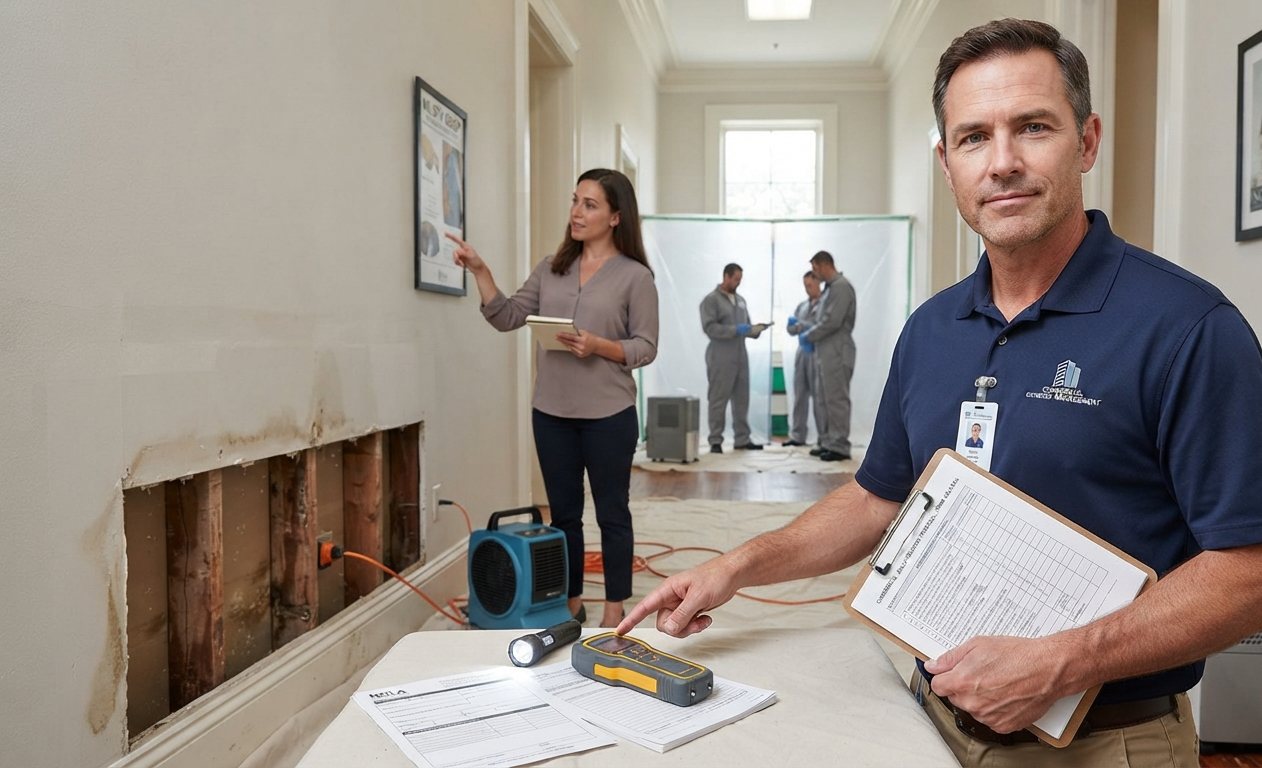
A tenant reports a musty odor, a hotel housekeeper notices ceiling staining, or an office manager finds wet drywall after a hard rain. A useful commercial mold response plan in New Orleans does not begin by guessing the species or ordering every available test. It begins with controlling water, protecting people and operations, documenting what is known, and assigning each decision to the right person.
Quick Answer
- Treat active water intrusion, electrical hazards, and unstable materials as immediate building-safety issues.
- Record the exact location, visible condition, odor, timing, weather pattern, recent repairs, and operating constraints.
- Find and correct the moisture source; cleaning growth without fixing the leak or condensation is usually temporary.
- Use inspection and sampling to answer defined questions, not as automatic steps for every complaint.
- Put work boundaries, access controls, documentation, verification, and reconstruction responsibilities in writing.
- Reopen only after the source is addressed, materials are dry, cleanup is complete, and agreed checks are satisfied.
The Goal Is a Controlled Response, Not an Instant Diagnosis
The first goal is to stabilize the situation and create a reliable decision trail. EPA guidance treats commercial mold response as moisture control, investigation, cleanup, communication, and follow-up—not a single test.
Start with the reported clue
Begin with the observed clue: staining, odor, damp material, condensation, visible growth, or a room that changes after rain or AC operation. That gives maintenance staff a useful starting point without assuming the cause.
Separate an active water emergency from a mold investigation
A roof leak, broken supply line, drain backup, or storm-driven water entry needs immediate water control and safety review. CDC and EPA guidance recommends drying or removing wet materials within roughly 24 to 48 hours when conditions allow.
Assign responsibility for communication and documentation
Name one incident lead to coordinate access, records, contractor documents, and updates. EPA’s commercial checklist recommends a remediation manager for medium or large problems and a designated contact for occupant questions.
The First Report: What the Property Manager Should Record
The first report should preserve enough detail to direct the inspection. It needs consistent facts, not a diagnosis.
Exact room and building location
Record the building, floor, room or unit, affected surface, and nearby plumbing, roof, exterior wall, window, restroom, kitchen, or HVAC component. “Dark spotting below the roof drain” is more useful than “mold upstairs.”
Odor, staining, visible growth, or wet material
Describe whether the material is damp, soft, swollen, peeling, discolored, fuzzy, or dry. Louisiana guidance lists musty odor, water staining, warped materials, bubbled paint, damp surfaces, and visible growth as common moisture clues.
Time and weather pattern
Record when the condition appeared and whether it changes after rain, overnight closure, or cooling cycles. A rain-linked stain suggests a different investigation from condensation that appears only while cold ductwork operates.
Known roof, plumbing, HVAC, or appliance issue
Check work orders for roof, condensate, plumbing, drain, appliance, sprinkler, and window problems. Relevant history may be filed under equipment or maintenance rather than “mold.”
Occupancy and access limitations
Note occupancy, operating hours, customer traffic, security restrictions, and blocked access. A vacant storeroom can be isolated differently from a hotel corridor, classroom, medical area, or public counter.
Photographs and prior work orders
Take wide photographs for location and close images of the material and likely water path. Keep dates, work orders, drying records, and prior complaints together; New Orleans continuity guidance also emphasizes accurate records after wind or water disruption.
Triage the Incident by Urgency
Urgency should reflect continuing moisture, safety hazards, occupied-space impact, and potential spread—not color.
Active water intrusion
Active water takes priority because continued wetting enlarges the affected area. Stop or isolate the source, restrict access, and document the path before finishes are opened. An active leak should move directly into the first-48-hours water and mold response.
Wet electrical or structural components
Do not send routine staff into standing water near energized equipment, sagging ceilings, or unstable materials. Secure the area and involve the appropriate electrical, structural, roofing, plumbing, or emergency authority before cleanup proceeds.
Visible growth in an occupied area
Limit unnecessary contact and avoid brushing, sanding, or blowing air across the material. Define the area, investigate moisture, and decide how occupancy will be managed while work is assessed and planned.
Musty odor without a visible source
A persistent odor may come from damp material behind finishes, flooring, ceilings, cabinets, or HVAC equipment. Maintenance teams can trace a musty odor before selecting the service.
Recurring complaint after previous repair
A repeat complaint may mean earlier work treated the surface, missed concealed moisture, or failed to correct the source. Compare prior records and inspect beyond the repaired finish.
Multiple rooms or units reporting the same clue
Several reports may point to a shared roof zone, plumbing stack, exterior wall, air handler, drainage issue, or storm exposure. Map complaints instead of treating each room as unrelated.
Adjust the Response to the Property Type
The core process stays the same, but access, containment, communication, and reopening vary by building use.
Multifamily and rental properties
Link each complaint to a unit, date, source investigation, repair, and closeout. Louisiana health guidance advises written renter notifications and identifies roofs, plumbing, windows, AC equipment, appliances, and water-heater pans as common leak locations.
Hotels and short-stay accommodations
A hotel room mold response should consider adjacent rooms, spaces above and below, shared plumbing, HVAC equipment, and housekeeping observations. Management should coordinate room status and relocation.
Offices and retail properties
Plan around employees, customers, security, and sensitive equipment. An office mold remediation plan may require workstation moves, controlled pathways, evening work, and clear notice about open areas.
Schools and educational buildings
Coordinate with facilities leadership and administration, protect students and staff from the work zone, and avoid disruptive cleanup in occupied spaces. EPA’s commercial guidance was written specifically for building managers, custodians, schools, and similar facilities.
Healthcare and assisted-care environments
Coordinate with facility leadership, infection-prevention personnel, engineering, and required authorities. Remediation contractors should not independently decide clinical relocation or reopening; CDC provides separate guidance for healthcare facilities affected by water and wind damage.
Government and publicly managed buildings
Public facilities may require formal procurement, records retention, access controls, and approvals. Build those steps into the schedule before opening finishes, especially when stabilization and permanent repairs use different contracts.
Define the Roles Before Work Begins
Clear roles prevent gaps between leak repair, assessment, remediation, verification, and rebuilding. A responsibility matrix should separate mold removal, remediation, and restoration.
Property management
Management authorizes access, preserves records, coordinates occupants, and identifies who may approve changes. It also defines the immediate operational objective.
Maintenance staff
Maintenance can isolate accessible water, retrieve work history, protect unaffected property, and support access. Staff should not disturb extensive growth or exceed their training and safety procedures.
Plumber, roofer, or HVAC contractor
The relevant trade corrects the source. Roof, plumbing, drain, duct-insulation, condensate, or mechanical repairs should not remain an undefined part of cleanup.
Mold inspector or consultant
An inspector or consultant may map moisture, evaluate hidden concerns, recommend a scope, design sampling, or provide oversight. Define the role in writing.
Remediation contractor
The remediation contractor protects the work zone, removes or cleans materials, manages waste, and documents conditions. Scope-changing discoveries should be reported before additional work.
Reconstruction contractor
Reconstruction replaces finishes and assemblies removed during access or cleanup. Rebuilding should not conceal unresolved leaks, damp insulation, wet subflooring, or a cavity that has not received the agreed completion review.
Verification professional where required by the project
Some projects require independent completion review or sampling. Define the reviewer, criteria, timing, and report recipient before remediation starts.
Inspection and Testing Decisions for Managed Buildings
Inspection should lead; testing should answer a question that history, visual review, and moisture findings cannot. Use the same inspection-versus-testing decision framework for each reported area.
When visual and moisture findings may be sufficient
With visible growth and a clear leak, the actions may already be clear: correct the source, define affected materials, clean or remove them, and dry the assembly. EPA and Louisiana say routine sampling is often unnecessary.
When sampling supports a defined documentation question
Sampling may help when the source is unclear, concealed contamination is reasonably suspected, a protocol requires it, or agreed post-remediation verification includes it. The plan should state what result would change the project decision.
Establishing consistent sample locations
When sampling several areas, document location, room conditions, HVAC operation, comparison strategy, timing, and recent activity. Inconsistent conditions weaken comparisons.
Avoiding unnecessary repeated testing
Do not repeat sampling simply because a report lists a mold name. EPA notes there are no federal limits for mold spores and that air samples reflect only the collection moment; inspection and moisture control remain central.
Keeping health claims outside the property report
Property reports should document conditions, moisture, materials, work, and test interpretation. They should not diagnose illness or claim that a building result caused symptoms.
Building a Commercial Remediation Scope
A useful scope defines boundaries, occupant protection, material handling, drying, documentation, and completion. “Treat mold” is too vague.
Work-zone boundaries
Identify rooms, surfaces, cavities, equipment, access routes, and adjacent occupied spaces. Include a procedure for expanding the boundary if hidden damage appears.
Occupant and operations protection
State when the area must be vacant, who may enter, how pathways are controlled, and how nearby property is protected. Fit the plan to actual operations.
Containment and pressure-control decisions
Containment should match the project’s size, location, disturbance, HVAC configuration, and surrounding occupancy. EPA describes containment and personal protection as situation-dependent controls used to limit spread during remediation.
Material removal and cleaning
List materials for removal or cleaning and decisions dependent on exploratory access. Wallboard, insulation, carpet, ceiling tile, wood, and hard surfaces require different handling.
Drying and environmental control
Specify which assemblies must dry, how moisture will be monitored, and who determines completion. EPA notes that moisture meters can help track drying in wallboard, wood, carpet, brick, and concrete after water damage.
Waste movement through occupied buildings
Define bagging, carts, elevators, loading routes, temporary storage, pathway cleaning, and work hours. Occupied facilities may need routes separated from normal traffic.
Daily documentation
Daily records should identify personnel, work areas, removed materials, readings, photographs, discoveries, and approved changes. Consistent documentation supports verification and reconstruction.
Reconstruction handoff
State who confirms readiness for rebuilding and what records the next contractor receives, including source repair, drying evidence, boundaries, photographs, and limitations.
Business Continuity and Communication
Business continuity means maintaining safe operations where practical. Updates should use verified facts and one incident lead.
Relocating occupants or operations
Relocation may involve one room, unit, department, or team. Base the decision on work activity, access, hazards, facility policy, and appropriate authority.
Controlling access to the work area
Use barriers, signs, locked doors, escorts, schedules, and contractor check-in. Maintain access control through setup, removal, cleaning, verification, and demobilization.
Communicating what is known and unknown
State what was reported, which area is affected, whether active water has stopped, what is scheduled, and when the next update will come. Avoid speculation about species, blame, toxicity, or insurance coverage.
Avoiding speculative medical statements
Managers can acknowledge concerns without diagnosing. A neutral response says the building condition is being assessed and directs anyone with personal health questions to a qualified healthcare professional.
Maintaining a single incident record
Keep complaints, photographs, access logs, proposals, license checks, work orders, reports, readings, and reopening decisions together. One record helps reveal repeat failures.
Contractor Procurement and Louisiana Licensing
Procurement should confirm scope, experience, applicable licensing, site requirements, and documentation. Teams can adapt the New Orleans mold-contractor selection checklist to the building’s access and insurance requirements.
Confirming the proposed scope
Before approving the budget, compare the factors behind remediation estimates. Confirm that bids cover the same rooms, materials, containment, equipment, waste routes, verification, and reconstruction exclusions.
Checking applicable state licensing
The Louisiana State Licensing Board for Contractors currently states that a Mold Remediation license is required for remediation projects valued at $7,500 or more, with at least 24 hours of specified training for the qualifying party. Verify current status and requirements with LSLBC before award.
Comparing commercial experience
Ask about the relevant building type and operating constraints, not only general mold work. Contractors should explain phasing, access, occupied-space controls, and waste movement.
Reviewing insurance and site requirements
Confirm certificates, contract terms, safety orientation, access rules, elevators, alarms, and protection of sensitive systems. These requirements do not predict insurance coverage.
Defining after-hours and emergency access
Set authorized contacts, credentials, alarms, loading access, and approval authority for unexpected work. After-hours activity still needs safe access and documentation.
Completion, Verification, and Reopening
Reopening should follow agreed criteria, not the calendar. The source should be addressed, materials dry, cleanup complete, and planned checks satisfied.
Confirm the water source has been addressed
Record the source repair. If control is temporary, document the limitation and assign the permanent repair rather than closing the incident.
Confirm materials are dry
Use measurements appropriate to the material. A dry-looking surface may still conceal damp insulation, wallboard, subflooring, or cabinet bases.
Complete visual and cleaning checks
EPA guidance says completed areas should not retain visible mold, mold-damaged material, or persistent moldy odor. A favorable air sample should not replace visual and moisture review.
Review agreed verification results
Where independent review or sampling was specified, compare results with the written protocol and resolve exceptions before reopening. Do not invent thresholds afterward.
Document repairs and reopening decisions
Close the record with photographs, moisture evidence, reports, source-repair confirmation, reconstruction status, and reopening authorization. Schedule follow-up for weather-dependent or recurring sources.
Preventing Repeat Incidents
Prevention depends on finding patterns before small water problems become repeated projects. EPA’s core principle is that controlling mold requires controlling moisture.
Roof and envelope inspection schedules
Inspect roof drains, flashing, penetrations, windows, doors, and known weak points on a schedule and after severe weather. Link repairs to building zones.
AC drain and condensate maintenance
Track drain cleaning, pans, pumps, duct insulation, sweating surfaces, and cooling-season complaints. In New Orleans, condensation deserves the same attention as rain intrusion.
Plumbing-response procedures
Give staff a process for shutoffs, photographs, escalation, extraction, and checking adjacent spaces. Include water heaters, supply lines, appliances, and plumbing stacks.
Tenant and staff reporting channels
Make it easy to report odor, staining, dripping, soft materials, or condensation. Request location, timing, photographs, and weather or equipment patterns.
Post-storm building checks
After heavy rain or wind-driven water, inspect roof areas, upper floors, exterior walls, low spaces, and closed rooms. NOLA Ready advises drying salvageable water-damaged equipment and inventory quickly.
Tracking recurring rooms and building zones
Tag incidents by roof section, plumbing stack, exterior elevation, air handler, and unit line. Clusters reveal patterns better than isolated reports.
What Trusted Public Health and Cleanup Guidance Emphasizes
- Control the moisture source. Cleanup will not last if leaks, condensation, drainage, or humidity problems continue.
- Dry wet materials promptly. Public guidance commonly uses a 24-to-48-hour target when safety and conditions allow.
- Do not cover growth with paint. The affected material and water problem still need attention.
- Use protection suited to the project. Controls should reflect size, disturbance, location, occupancy, and building systems.
- Do not make routine air testing the default. Sampling should answer a defined question.
- Evaluate the whole project. Source repair, dryness, visual cleanliness, odor, documentation, and agreed verification all matter.
Frequently Asked Questions
What should a property manager do after a mold complaint?
Record the exact location, condition, timing, photographs, and recent leak or HVAC history, then check for active water and safety hazards. Assign one contact and document the inspection, repair, cleanup, and closeout.
Does every commercial mold complaint require air testing?
No. EPA and Louisiana guidance indicate that testing is often unnecessary when visible growth or an obvious moisture problem already supports corrective action. Sampling is more useful when it answers a defined hidden-condition, documentation, or verification question.
Can a hotel room remain occupied during nearby remediation?
It depends on the work-zone location, containment, HVAC connections, access, noise, occupant considerations, and hotel policy. Management should decide with the project team and appropriate facility authorities rather than using a universal distance rule.
Who should document commercial mold remediation?
The property manager should maintain the master incident record, while each trade documents its own work. The final file should connect the complaint, source repair, remediation, readings, photographs, verification, reconstruction, and reopening.
How is post-remediation verification handled in a managed building?
Verification should follow criteria agreed on before work begins. It may include moisture measurements, visual and odor checks, source-repair confirmation, documentation review, and sampling when the written protocol requires it.
Editorial Note
A commercial mold incident is primarily a moisture-management and building-operations problem. The record should connect the original clue to the water source, affected materials, corrective work, drying, verification, and reopening. This article provides general information only and is not medical, legal, insurance, engineering, environmental-consulting, or policy-coverage advice.
Discuss a Mold or Moisture Concern in a New Orleans Property
If a New Orleans apartment building, hotel, office, store, or managed facility has persistent moisture, staining, a musty odor, visible growth, or wet materials, call New Orleans Mold Fix at (504) 520-4589 to discuss the affected area and practical next steps.